The Architecture of False Safety: 7 Red Flags

HomeSurviving DailyWomanism/Feminism

The Architecture of False Safety: 7 Red Flags

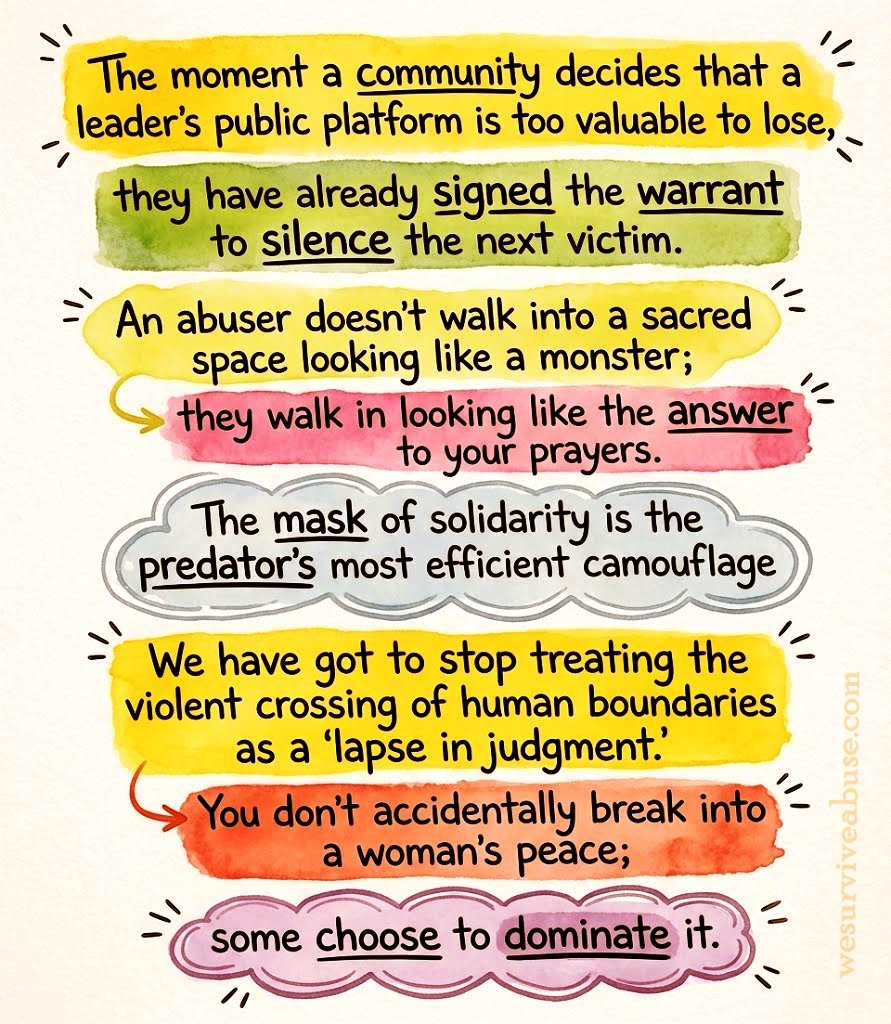
We have got to stop treating the violent crossing of human boundaries as a 'lapse in judgment.' You don't accidentally break into a woman's

Calling Women “Hateful” for Wanting Safety Is Abuse Dressed in Decorum
People Don’t Just “Ignore Red Flags” — They’re Protecting Something
Avoid Praising Harm: How Women Can Break the Cycle of Defending Those Who Do Damage
🧨 Myth: “Abuse Survivors Are Just Broken People Who Pick Bad Partners”
Inclusion Should Never Cost Girls Their Safety

We have got to stop treating the violent crossing of human boundaries as a ‘lapse in judgment.’

You don’t accidentally break into a woman’s peace; some choose to dominate it.


Often toxic entitlement can hide behind a compelling narrative until the truth forces its way into the light. Now that others are seeing the red flags at the same time, let’s review what they are:

It’s a pattern of total disregard for safety, consent, and basic truth.


  • Violating Sacred Spaces and Boundaries: The breaking point came with the harrowing account from a former partner who revealed that Platner entered her home while intoxicated and forced himself on her after being told to stop. It was a direct, violent violation of a woman’s private space and personal autonomy.

  • The Facade vs. The Reality: He pitched himself as a regular, working-class guy who understood struggle and accountability. In reality, multiple reports have exposed a trail of volatile, physically threatening behavior toward past partners, coupled with explicit deception.

  • The Symbols of Violence: The revelation of his Nazi-era Totenkopf chest tattoo—and the fact that he reportedly joked about its meaning in private while publicly claiming ignorance—directly points to an entitlement to play with symbols of a violent, hateful regime without carrying the conscience of what they represent.

  • A History of Physical Intimidation: Long before the recent breaking-and-entering report, former partners described an ongoing pattern of control. An investigative report in The New York Times detailed accounts from a previous relationship where he frequently used physical force during arguments—grabbing a partner by the shoulders hard enough to leave marks, twisting her arm, and physically trapping her in a room.

  • Deception as a Baseline: He built his campaign on the image of a reformed, accountable man, yet that facade was actively crumbling in private. Even recently, shortly after getting married, he was caught sending sexually explicit messages to other women—showing that the boundary-testing and entitlement weren’t just “in the past.”

  • The Weaponization of an Ideology: The handling of his Totenkopf Nazi tattoo fits perfectly into this pattern of deception. Publicly, he claimed it was an ignorant mistake from his youth that he didn’t understand. Privately, however, partners revealed he knew exactly what it meant and treated it as a joke. He was comfortable harboring a symbol of explicit violence while lying to the public to protect his ambitions.

  • Deep-Seated Misogyny: His history on public forums revealed a long-standing contempt for women. Years ago, he posted comments online explicitly blaming sexual assault victims and telling them to “take responsibility.” While he tried to dismiss these as old posts from a dark period of untreated PTSD, his real-world actions over the decade that followed proved those weren’t just empty words; they reflected how he actually treated women behind closed doors.

    We all have a public and private self. We all have things that we don’t tell others. Every single human being carries a shadow. We all have private regrets, secrets, moments where we were selfish, or thoughts we would be mortified to have broadcast on the evening news. That is just the baseline of being an imperfect human. Sometimes, that is why people defend this toxic behavior. They are thinking of their own stuff. 

     Mistakes vs. Violations of Autonomy

    • Normal Messiness: A regular person might lose their temper, say something cruel, or act out of alignment with their values. But standard human mistakes stop where another person’s basic physical safety and bodily autonomy begin.

    • Toxic Patterns: Breaking into a woman’s home, ignoring a literal “no” to force yourself on her, or using physical intimidation to trap someone in a room—these are not “crusty details” or “bad days.” They are systematic violations of human rights. Regular people do not have “secrets” that involve erasing the consent of the people around them.


    And What Happens When the Truth Comes Out

    The ultimate differentiator is how a person responds when the light hits the secret:

    • A regular person confronted with their mess usually experiences genuine remorse, faces the music, and accepts the consequences because they care about the truth and the people they hurt.

    • A toxic figure—even in their final exit, like Platner’s defiant 11-minute video—will blame the “establishment,” the media, or “structural pressure.” They will play the victim, gaslight the public, and try to burn down the room rather than look in the mirror. And their supporters and enablers will often do the same. 


    The Bottom Line: We all have a backyard with some weeds in it. But there is a world of difference between having a yard of weeds you’re embarrassed about, and running a toxic waste dump under a manicured front lawn. The outrage isn’t because he was an imperfect man with secrets; it’s because he used a promise of safety to hide a reality of violence.

    Women have warned about this pattern before and been dismissed. Now would be a good time to listen to the women and others who have been attempting to warn others.

    It is human, we all must try to remember this pattern and these red flags and remember to apply them to the men in our lives and spaces too. 


    You Are Not a Hero to Women for Teaching Men They are Entitled to Women’s Spaces (podcast episode) – WE Survive Abuse
 

Spread the love