This list is brilliant because it captures the messy truth so succinctly.This list is usually credited to a second-wave feminist who goes by the o
This list is brilliant because it captures the messy truth so succinctly.
This list is usually credited to a second-wave feminist who goes by the online username “TheBewilderness” (also referred to as “Rose” in some write-ups), who wrote it with input from friends/other women online. Rose, described as a 73-year-old second-wave feminist who goes by the username “TheBewilderness” online, wrote the “Rules of Misogyny” with the help of her friends. It originally had only nine rules, and the list expanded over time to name an increasing number of male patterns.
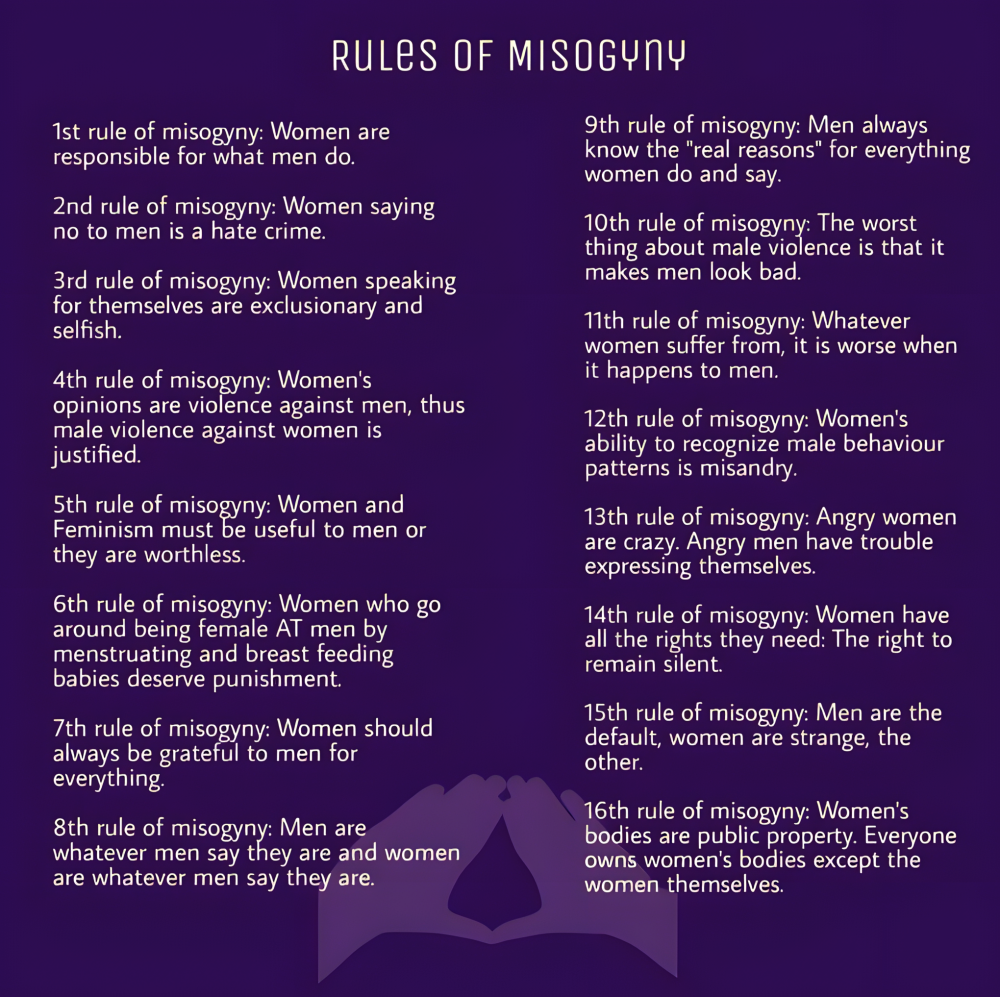
Here are the two commonly circulated versions, compiled from multiple sources. Wording varies slightly between reposts, but this is the most consistent version of each.
14-Rule Version
- Women are responsible for what men do.
- Women saying no to men is a hate crime.
- Women speaking for themselves are exclusionary and selfish.
- Women’s opinions are violence against men, thus male violence against women is justified.
- Women and Feminism must be useful to men or they are worthless.
- Women who go around being female AT men by menstruating and breastfeeding babies deserve punishment.
- Women should always be grateful to men for everything.
- Men are whatever men say they are, and women are whatever men say they are.
- Men always know the “real reasons” for everything women do and say.
- The worst thing about male violence is that it makes men look bad.
- Whatever women suffer from, it is worse when it happens to men.
- Women’s ability to recognize male behavior patterns is misandry.
- Angry women are crazy. Angry men have trouble expressing themselves.
- Women have all the rights they need: the right to remain silent.
16-Rule Version (extended)
Same as above through rule 14, with two additional rules appended:
- Men are the default human. Women are strange, subhuman others.
- Everyone owns and controls women’s bodies except the women themselves.
Notes on variation between reposts:
- Some versions list rule 13 as “Women are not oppressed! Rape and catcalling and objectification are all compliments, not oppression” instead of the “angry women are crazy” line — different threads seem to have branched and evolved separately.
- The Mumsnet thread has yet another variant for rule 11: “Basic pattern recognition skills are cruel and evil when they hurt men’s feelings,” and rule 12 as “whatever women suffer from, men suffer from more” — suggesting some paraphrasing/reordering happened as it spread.
Origin
The list is credited to a poster known online as “TheBewilderness” (also referred to as “Rose,” said to be a second-wave feminist). It originally had only nine rules. The earliest documented trace in these results is a 2018 Twitter thread where @thebewilderness posted the rules, and around the same time it was circulating on the UK parenting forum Mumsnet — a May 2018 Mumsnet thread already lists rules up through the 12th, with a poster noting she was trying to formulate an additional one about women’s “right to remain silent.” 4W + 2
Growth by accretion
Mumsnet is where you can watch the mutation happen in real time. Users didn’t just repost the list — they added to it. One Mumsnet contributor notes she’s sure she’s seen additional rules but can’t remember them, suggesting the thread itself as a place to post more, and a later 2020 Mumsnet thread (“17 Rules of Misogyny in pictures”) confirms the list “has been added to over the years,” with some rules possibly originating on Mumsnet itself. That same thread shows people uncertain of its authorship — one asks whether it was “just an internet thing” or perhaps originally from Andrea Dworkin — which is a classic folklore signature: once something’s viral enough, people start attaching it to a more “authoritative” originator than the actual one. Mumsnet + 2
Branching wording
By the time it reached wider circulation, the phrasing had forked. Compare rule 13: some versions render it as “Angry women are crazy. Angry men have trouble expressing themselves,” while the Bezoar Tumblr version instead reads “Women are not oppressed! Rape and catcalling and objectification are all compliments, not oppression.” Numbering also drifted — the same idea sometimes sits at a different rule number depending on which lineage you’re reading (e.g., the “right to remain silent” line appears as rule 12 in one Mumsnet thread and rule 14 elsewhere). Tumblr
Platform migration and canonization attempts
From Twitter/Mumsnet it moved to Tumblr (2022), Facebook via RadFem Collective (2021), and eventually got picked up by more curated outlets trying to “fix” a canonical version — 4W.pub explicitly says it’s reprinting the rules “with permission” specifically to help maintain a record, which is itself an interesting move: an attempt to arrest the drift by publishing an authoritative version, the way a scribe might try to standardize an oral epic. 4W
Extension and repurposing
By 2024–2025 the list had grown again, to 16 rules, with two new additions about men being treated as the “default human” and about ownership of women’s bodies. It also got applied to new contexts entirely — For Women Scotland invoking it in commentary on the Sandie Peggie tribunal case at NHS Fife, using the list as an interpretive lens for a real news event. For Women Scotland
That last move — using the list to explain a court case — is the clearest sign it’s graduated from “meme” to something closer to a shared cultural reference point within a particular political community, the way an idiom or proverb gets pulled out to make sense of new situations rather than just repeated for its own sake.
12 Things Women Have Always Been Told Don’t Matter—But Actually Matter Deeply – WE Survive Abuse