updated from 2/5/25 I exchanged emails with this mother, Carolyn Mosley, many years ago. I don't think I will ever forget she and her d
updated from 2/5/25
I exchanged emails with this mother, Carolyn Mosley, many years ago.
I don’t think I will ever forget she and her daughter’s story.
During a season when I was speaking to youth about teen dating violence, I knew I could not only speak in general terms.
Young people needed to hear about young people.
Not statistics only.
Not distant warnings.
Not adult lectures wrapped in fear.
They needed to know that relationship violence can happen to someone their age. Someone smart. Someone loved. Someone with dreams, leadership, friendships, and a future.
That search led me to the story of Ortralla Mosely.
Ortralla was a teenager.
She was murdered at school by the boyfriend she had recently broken up with.
I am a mother. I did not want to speak about another mother’s child without permission, care, and blessing. Ortralla’s mother, Carolyn Mosely, graciously extended that through a series of email exchanges.
That mattered to me then.
It still matters now.
Because when we tell the stories of girls whose lives were stolen, we are not using them as examples.
We are bearing witness.
We are saying: this child mattered. This mother mattered. This warning mattered. And we had better learn something before another child is harmed.
Stolen Joy
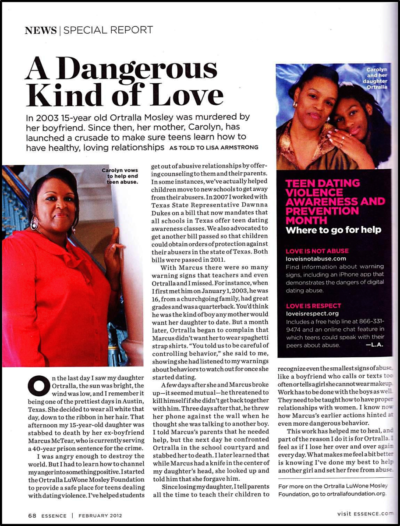
Carolyn Mosley in Essence Magazine 2012
Thirteen days after Carolyn Mosely, a single mother of three, got married, her youngest daughter was murdered.
At school.
Her baby.
The scene was so horrific that even teachers were screaming.
“Not a student.”
“Not a great student like Ortralla Mosley.”
“At school.”
That is part of what makes this story so painful. Ortralla was not somewhere hidden away from the world. She was not isolated in a place where no adult could possibly notice anything.
She was at school.
A place where young people are supposed to learn, grow, laugh, plan, and become.
Ortralla was known as a good student. She was smart. She was focused. She was a cheerleader and a leader on her school dance squad.
After she died, one of her English teachers spoke about how other girls went to Ortralla when they had problems.
That tells us something important.
Ortralla was not only loved.
She was trusted.
She was the kind of girl other girls recognized as steady, capable, and strong.
And when she realized that her relationship with 16-year-old Marcus Mctear was interfering with her progress, she broke up with him.
That decision deserves to be named clearly.
Ortralla chose herself.
She chose her future.
She chose her peace.
She chose not to let a controlling and possessive relationship stand in the way of who she was becoming.
And for that, her life was taken.
An Extremely Painful Day
In the beginning, Marcus Mctear may have seemed like a good match for Ortralla. He was a football player at another high school. He was looked up to by some of his peers.
But admiration is not the same thing as safety.
Popularity is not the same thing as character.
Being talented, athletic, charming, or well-known does not mean a young person is healthy in a relationship.
That is one of the hard lessons adults have to sit with.
According to reports, Marcus had already been the subject of multiple school disturbance reports. Too often, when boys are athletes or socially valued, warning signs are softened, excused, or treated as ordinary misbehavior.
But controlling behavior is not ordinary.
Jealousy is not romance.
Possessiveness is not devotion.
And prior violence or intimidation should never be brushed aside because a young man is “promising.”
A security guard reportedly saw Ortralla and Marcus arguing that morning.
Later that same day, around 4 p.m., Marcus approached Ortralla armed with two knives and stabbed her six times.
She died at the scene.
Defensive wounds showed that Ortralla fought for her life.
In a matter of minutes, someone who claimed to care about her stole that life.
Her mother received a pager notification from another student. By the time Carolyn arrived at the hospital, someone else had already identified Ortralla.
Her daughter was in the morgue.
 What Her Mother Was Not Told
 What Her Mother Was Not Told
One of the most painful parts of this story is what Carolyn Mosely did not know.
She later said that if she had known the conflict between Ortralla and Marcus seemed to be escalating, she would have gone to her daughter. She would have checked on her. She would have done what mothers do when they know their child may be in danger.
But she was not told.
She was not informed about the argument that happened the morning Ortralla was killed.
She did not receive a fuller picture from the school until later.
And according to news reports, Carolyn said she never received a single condolence call from the school or any official in the district.
That absence matters.
When a child is harmed, schools cannot retreat into procedure so deeply that the family is left without basic human care.
Investigations matter.
Legal processes matter.
But a grieving mother should not have to wonder whether the institution where her child died remembers that her child was human.
Red Flags That Became Clear Later

Looking back, Carolyn remembered warning signs.
Marcus had complained about Ortralla’s clothing being “too revealing.”
That is not a small detail.
It may sound familiar to many adults because controlling behavior often disguises itself as concern, morality, protection, or jealousy.
But when a young person starts monitoring what another young person wears, where they go, who they talk to, how they act, or how much attention they receive, adults need to pay attention.
Carolyn had corrected him. She reminded him that Ortralla’s mother bought those clothes and that her mother was fine with what Ortralla chose to wear.
Still, the relationship lasted only five months.
And Carolyn was not aware of major issues until the day after her wedding, while on her honeymoon, when Ortralla contacted her to say Marcus had tried to cut his own throat.
The newlyweds ended their honeymoon to respond to a family crisis.
That moment reveals another important truth.
Teen dating violence does not only harm the young person being targeted.
It shakes families.
It interrupts homes.
It creates fear, confusion, urgency, grief, and trauma across generations.
This Was Not His First Abusive Relationship
According to reports, this was not the first time Marcus had been abusive toward a fellow student.
The mother of another student said she saw her daughter come home with bruises. She reportedly tried to contact the school principal but did not receive a response. After Marcus allegedly pushed her daughter down a flight of stairs, that mother moved her daughter to another school.
That detail should stop us.
Because sometimes there are warnings before the tragedy people finally notice.
Sometimes another girl was harmed first.
Sometimes another mother tried to speak.
Sometimes another family made a hard decision quietly because they could not get the help they needed loudly.
When schools fail to respond to early warning signs, the danger does not disappear.
It moves.
It grows.
It finds another girl.
A Mother’s Love in the Middle of Grief
Despite the silence Carolyn experienced from officials, she showed up for the students.
She spoke to them over the school P.A. system.
She assured them that Ortralla loved them.
She comforted them.
She helped steady young people who were frightened, devastated, and unsure what to do with their pain.
There were concerns about more violence. About vengeance. About children trying to respond to pain with more harm.
And in the middle of her own unimaginable grief, Carolyn brought comfort.
That is a mother’s love.
Not soft in the shallow sense.
Strong.
Sacrificial.
Clear-eyed.
Grief-stricken and still reaching for the living.
Carolyn also publicly expressed that Marcus needed help.
That does not erase what he did.
It does not soften the loss.
It does not make the violence less serious.
It shows the moral complexity that many mothers, Survivors, and grieving families carry.
They can want accountability and still recognize that something is deeply wrong when a young person becomes that dangerous.
Schools Are Not Separate From Teen Dating Violence
Parents often feel guilt when they later learn their child was struggling in a dating relationship.
But much of teen dating violence does not happen while parents are watching.
It happens in hallways.
On buses.
In cafeterias.
Online.
After class.
Near lockers.
In bathrooms.
At games.
During school events.
In small rooms, corners, stairwells, and places adults pass by without noticing enough.
Girls may tell other girls first.
Students may know before parents know.
Teachers may see pieces.
Security staff may see arguments.
Counselors may hear rumors.
Friends may witness threats.
And if there is no clear plan, all those pieces remain scattered until something terrible happens.
Schools cannot keep treating teen dating violence as a surprise.
Students spend a large part of their lives in school, surrounded by peers, social pressure, romantic drama, jealousy, rumor, rejection, public embarrassment, and fear.
That means schools need more than a “be nice” poster in the hallway.
They need a prevention plan.
They need a response plan.
They need a follow-up plan.
They need a way to notice patterns before a child is hurt.
What Teen Dating Violence Can Look Like
Teen dating violence is not always easy for adults to recognize.
It may look like:
A boyfriend or girlfriend monitoring clothing, phone use, friendships, or social media.
A young person becoming anxious about upsetting their partner.
Constant arguments at school that adults dismiss as “teen drama.”
A student suddenly pulling away from friends, activities, or leadership roles.
A partner showing up uninvited or refusing to leave the other person alone.
Threats of self-harm used to stop a breakup.
Public humiliation, name-calling, or rumors after rejection.
Bruises, injuries, or explanations that do not sound complete.
Friends seeming worried but afraid to say too much.
A student trying to end a relationship but being stalked, pressured, or punished for leaving.
None of these signs should be ignored.
Not because every sign means murder is coming.
But because every sign means a young person may need help, guidance, and protection.
What Adults Can Do
1. Take teen relationships seriously.
Adults sometimes minimize teen dating because the relationship seems young, temporary, or immature.
But young people can experience real fear, real coercion, real violence, and real danger.
A short relationship can still be dangerous.
A young abuser can still be dangerous.
A breakup can still be a high-risk moment.
2. Teach that possessiveness is not love.
Young people need to hear this early and often.
Love does not require control.
Love does not monitor your clothes.
Love does not punish you for having friends.
Love does not threaten self-harm to keep you from leaving.
Love does not make you smaller.
3. Build strong guidance and mental health support in schools.
Good guidance counselors are not extras.
Mental health professionals in schools are not luxuries.
Students need safe adults who are trained, available, culturally aware, and prepared to respond when a young person is frightened or being controlled.
4. Include coercive control in relationship education.
If a school teaches sex education or health education, coercive behavior should be part of the conversation.
Young people need language for what it looks like when someone pressures, threatens, isolates, manipulates, stalks, humiliates, or controls them.
They need to know that abuse is not only physical.
They need to know that fear is information.
5. Do not leave children to solve adult-sized problems alone.
Many adults struggle to navigate unhealthy relationships.
We cannot expect teenagers to handle dangerous relationship dynamics by themselves.
They need privacy, yes.
They need growing independence, yes.
But they also need adults who pay attention to silence, mood changes, fear, withdrawal, and sudden shifts in behavior.
6. Make it safe for teens to tell the truth.
Young people may hide what is happening because they fear punishment, judgment, embarrassment, or losing freedom.
They may worry adults will take their phones, shame them, blame them, or make everything worse.
Teens should know:
Even if you made a mistake, you can still ask for help.
Even if you went somewhere you were not supposed to go, you can still ask for help.
Even if you sent a message you regret, you can still ask for help.
Even if you defended the person before, you can still ask for help.
Even if you are embarrassed, you can still ask for help.
Safety comes first.
Correction can come later.
7. Define safe adults clearly.
Young people need more than the phrase “talk to a trusted adult.”
Some children and teens do not know who is safe.
A safe adult is someone who:
Wants the best for you.
Takes your fear seriously.
Does not shame you for needing help.
Does not protect the harmful person’s reputation over your safety.
Helps you think through your options.
Gets additional help when the situation is dangerous.
Respects your dignity while helping protect your life.
Safe adults do not have to be perfect.
But they do need to be protective, steady, and willing to act.
What Schools Need in Place
Every school should have a teen dating violence safety plan that includes:
A clear reporting process for students, parents, teachers, and staff.
Training for staff on warning signs of coercive control, stalking, and escalation.
A policy for notifying parents or guardians when there are credible safety concerns.
Safety planning after breakups, threats, fights, or stalking behavior.
Documentation of repeated disturbances, threats, and violent behavior.
Serious follow-up when a student or parent reports relationship violence.
Coordination with counselors, administrators, school resource officers, and community advocates.
Protection from retaliation, bullying, or public humiliation after a breakup.
Support for the targeted student’s friends, who may also be afraid or traumatized.
A compassionate communication plan for families after serious incidents.
Schools do not need to wait until there is a tragedy to build this.
They can start now.
A Word to Parents and Caregivers
If your child is dating, try to wade deeper than, “Do you like them?”
Maybe ask:
Do you feel peaceful around them?
Do they respect your no?
Do they get angry when you spend time with friends?
Do they criticize your clothes, body, or personality?
Do they make you feel guilty for having boundaries?
Are you afraid to break up with them?
Have they ever threatened to hurt themselves or someone else if you leave?
Do you feel like you have to manage their emotions all the time?
Has anyone at school seen behavior that worries them?
Is there anything you have been afraid to tell me because you thought I would be mad?
Then listen.
Not with panic first.
Not with punishment first.
Listen for what your child is trying to survive.
A Word to Teens
If someone makes you afraid, that matters.
If someone threatens you after a breakup, that matters.
If someone says they will hurt themselves because you are leaving, that matters.
If someone controls your clothes, friends, phone, movement, or reputation, that matters.
If you feel like you cannot breathe, think, study, laugh, or be yourself because of the relationship, that matters.
You do not have to wait until it gets “bad enough.”
You can ask for help now.
You can tell more than one adult.
You can keep telling until someone listens.
And if the first person minimizes it, that does not mean you were wrong.
It means you need another safe adult.
The Lesson We Cannot Afford to Miss
Ortralla Mosely was not only a victim of teen dating violence.
She was a daughter.
A student.
A friend.
A leader.
A girl with a future.
She noticed that a relationship was interfering with her progress, and she chose to end it.
That should have been the beginning of more freedom.
Instead, it became the point of greatest danger.
That is why teen dating violence prevention cannot be treated as optional.
It belongs in schools.
It belongs in parent conversations.
It belongs in youth programs.
It belongs in churches, community centers, sports programs, mentoring spaces, and anywhere young people are being shaped.
Because young people are already dealing with relationship pressure.
The question is whether adults are prepared to help them survive it.
Closing Reflection
We cannot bring Ortralla back.
But we can refuse to let her story be reduced to a tragic headline.
We can listen more closely when girls speak.
We can take controlling behavior seriously before it turns deadly.
We can stop excusing danger because a boy is popular, athletic, charming, troubled, or “going through something.”
We can build schools where warning signs are not scattered across adults who never compare notes.
We can tell young people the truth:
A relationship that costs you your peace is asking too much.
A relationship that punishes your growth is not love.
A relationship you are afraid to leave is already unsafe.
And a child should never have to stand alone between their own future and someone else’s control.

5.

Teen Dating Violence: The Comeback Trap | WE Survive Abuse
The Days of Girls | WE Survive Abuse
Empowering the Girls ….ONLY | WE Survive Abuse
Big Life Lessons That Teach Black Girls to Silence Their Pain: Um, The Hair | WE Survive Abuse
Gaslighting and Red Flags: Black Women & Girls and Safety | WE Survive Abuse
Are You Sure That You Are Listening to Women and Girls? (audio & blog post) | WE Survive Abuse
19 Signs You May Not Be as Pro-Woman as You Believe You Are | WE Survive Abuse
Are You ‘Tolerating’ More Hate Than You Think? | WE Survive Abuse
(UPDATE) We Teach Girls To Say “No”, Until: The Brave Girls in Vermont | WE Survive Abuse
An Infographic Explanation of the Word “No” (infographic) | WE Survive Abuse