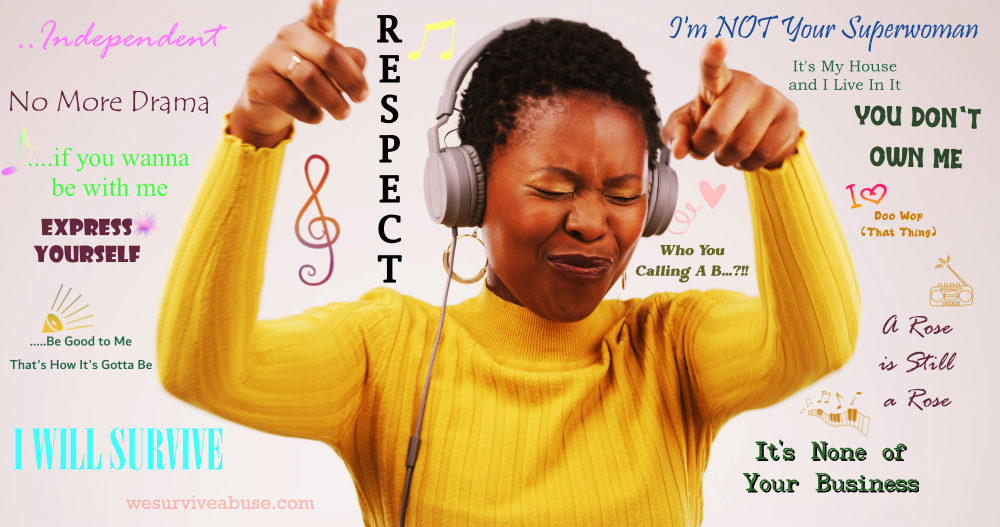
updated from April 2025 "We're supposed to pretend that if we are "good girls," a "good man" will find us and give us everything that we want.
updated from April 2025
“We’re supposed to pretend that if we are “good girls,” a “good man” will find us and give us everything that we want.
About money. About love. About what it means to be valued.
This conversation didn’t start online.
Long before timelines, hashtags, and debates, Black women artists were already telling the truth—plain, direct, and often ahead of their time. They weren’t just singing about love. They were naming patterns. Setting standards. Drawing lines.
They were telling women how to live well. Safety. Self Respect. Self Worth. Self Love.
These weren’t just songs.
They were instructions. Warnings. Blueprints. Survival strategies set to rhythm.
From vinyl to streaming, Black women have been laying it down:
how to choose, how to leave, how to protect your peace, your body, your labor, your dignity.
And if you listen closely, there’s a clear pattern.
It starts before the harm.
It names the harm.
It survives the harm.
And then it rebuilds.
I. Before It Breaks: The Warnings
Candi Staton – “Young Hearts Run Free” (1976)
“What’s the sense in sharing this one and only life…”
This is where it begins.
Not in the middle of chaos—but before it.
Candi Staton was speaking from experience. She knew what it meant to get caught up in love without safety, without clarity, without protection. And she said it plainly: not every relationship is worth the cost.
What she taught us:
Excitement is not safety. Choose carefully before you’re choosing how to survive.
Aretha Franklin – “Respect” (1967)
“All I’m askin’ is for a little respect…”
Before anything else—this.
She didn’t frame respect as something to earn. She set it as the baseline.
What she taught us:
If respect is missing at the beginning, everything else will be unstable.
Lauryn Hill – “Doo Wop (That Thing)” (1998)
“How you gon’ win when you ain’t right within?”
Lauryn spoke to both sides—but she was especially clear with women.
Don’t trade your worth for attention. Don’t abandon yourself to be chosen.
What she taught us:
Self-respect is not optional. It’s protection.
II. The Line Is Drawn: Standards and Boundaries
Gwen Guthrie – “Ain’t Nuthin’ Goin’ On but the Rent” (1986)
“You’ve got to have a J-O-B…”
This wasn’t harsh. It was honest.
Partnership requires contribution. Not vibes. Not promises. Contribution.
What she taught us:
You are not here to carry another adult.
Destiny’s Child – “Bills, Bills, Bills” (1999)
“Can you pay my bills?”
A clear picture of imbalance.
One person giving. One person taking.
What they taught us:
If being with someone drains you, that is the answer.
Diana Ross – “It’s My House” (1979)
“I bought it with my own money…”
Ownership. Authority. Control.
No negotiation.
What she taught us:
What you build, you protect.
Destiny’s Child – “Independent Women Part I” (2000)
“I depend on me.”
Not isolation. Not rejection.
Preparation.
What they taught us:
Independence keeps you from being trapped.
Janet Jackson – “Nasty” (1986) + “Let’s Wait Awhile” (1987)
Two messages. Same power.
Don’t disrespect me.
You don’t get access to me on demand.
What she taught us:
You control the pace. You control the terms.
Salt-N-Pepa – “None of Your Business” (1993)
A direct refusal of shame. Mind your business when it comes to her, the same way that you do when it comes to him.
What they taught us:
Your life is not up for public control or commentary.
Queen Latifah – “U.N.I.T.Y.” (1993)
“Who you callin’ a b**?”
No softening. No sidestepping.
What she taught us:
You define how you are spoken to—and what you will not tolerate.
The S.O.S. Band – “Weekend Girl” (1983)
“I’m a weekend girl…”
But listen closely—this is not resignation.
This is structure.
He wants more access. More time. More presence.
And she’s the one setting the terms.
She’s not chasing. Not waiting. Not rearranging her life to be chosen.
She’s saying: this is what I’m available for—and nothing beyond that.
No overextension. No emotional scrambling. No bending herself into something more convenient for him.
What she taught us:
Access to you is something you define—not something others expand at will.
III. The Breaking Point
Karen White – “Superwoman” (1988)
“I’m not your superwoman.”
This is the moment it clicks.
You’ve been carrying too much. Loving too hard. Holding everything together for someone who is not holding you.
And then—something shifts.
This song lived on through remakes by other legendary women because that realization keeps happening.
What she taught us:
You are not responsible for overfunctioning in someone else’s absence.
Mary J. Blige – “Not Gon’ Cry” (1995)
The quiet devastation.
Giving everything. Still not enough.
What she taught us:
There comes a moment when you stop pouring into what cannot hold you.
IV. The Exit and the Rebuild
Mary J. Blige – “No More Drama” (2001)
“No more pain…”
This is not just leaving a person.
This is leaving chaos.
Choosing peace—even when it costs you familiarity, history, or connection.
What she taught us:
Peace is a decision. And once you choose it, everything that disrupts it has to go.
Gloria Gaynor – “I Will Survive” (1978)
“At first I was afraid…”
This is the anthem for what comes after.
Not just survival—but standing back up. Reclaiming space. Rebuilding a life.
What she taught us:
Survival is not the end. It’s the turning point.
V. What Remains: Identity and Self-Worth
Aretha Franklin – “A Rose Is Still a Rose” (1998)
“A rose is still a rose…”
After everything—this truth remains.
No matter what was done. No matter what was said. No matter what was taken.
You are still you.
What she taught us:
Your value does not decrease because someone failed to recognize it.
Whitney Houston – “The Greatest Love of All” (1986)
“I decided long ago…”
This is the foundation.
When everything else falls away—this must remain.
What she taught us:
You must be a place of refuge for yourself.
Chaka Khan – “I’m Every Woman” (1978)
A celebration—but also a correction.
Women have always been capable. That was never the question.
What she taught us:
Being capable does not mean being endlessly available.
Tina Turner – “You Better Be Good to Me” (1984)
“That’s how it’s gotta be now.”
What she taught us:
After survival, your standards rise.
Honorable Sisterhood
🖤 Lesley Gore – “You Don’t Own Me”
🖤 Dolly Parton – “9 to 5”
🖤Reba McEntire- “Why Haven’t I Heard From You”
Because truth travels.
*These are just MY personal faves. Flip through the country genre for more. And the blues and jazz has a lot of women telling it like it is.
And here’s what holds it all together:
There’s a quiet push right now trying to convince women that independence is a flaw.
That standards are excessive.
That asking for reciprocity is unreasonable.
But this body of work says something else.
Across decades, these women made it plain:
Women were never asking for too much.
They were asking for what should have already been there.
Respect. Contribution. Care. Balance.
And when it wasn’t there—they said it.
Clearly. Repeatedly. Publicly.
💥 You do not become valuable when someone treats you well.
You were already valuable—before they ever showed up. 💥
*NOTE: This is not meant to be definitive. Hopefully it is just the beginning of many conversations around how women have strategically spoken out in a world that demanded silence.
She really did that.