One of the most dangerous assumptions in the world is believing that if a woman does not openly object, she must be okay with what is
One of the most dangerous assumptions in the world is believing that if a woman does not openly object, she must be okay with what is happening.
Many women have learned that speaking up can come with consequences. Sometimes those consequences are social. Sometimes they are financial. Sometimes they are physical. Sometimes they are deadly.
Silence is not always agreement.
Sometimes silence is fear.
Here are 15 reasons a woman may not speak up even when she wants something to stop.
1. She Is Assessing the Danger
When a woman feels unsafe, her first priority may not be expressing her opinion. Her first priority may be figuring out how to get through the situation safely.
Many women are constantly evaluating risk. They are watching body language, tone of voice, exits, bystanders, and possible outcomes.
2. She Has Seen What Happens When Women Say No
Women do not have to imagine the consequences.
They have watched other women be insulted, harassed, stalked, threatened, assaulted, fired, excluded, ridiculed, and even killed after rejecting a man’s advances or challenging his behavior.
Those lessons travel.
3. She Has Been Conditioned to Be Polite
From an early age, many girls receive messages about being nice, accommodating, pleasant, and agreeable.
Too often, girls learn to protect other people’s comfort before protecting their own.
4. She Is Outnumbered
A woman surrounded by people who are dismissing her concerns may choose silence because she recognizes that she has little support in that moment.
Being alone in a room full of people can be frightening.
5. She Is Trying to Avoid Escalation
Some women remain quiet because they are trying to prevent a situation from becoming worse.
They are not agreeing.
They are attempting to survive.
6. She Has Experienced Retaliation Before
A woman who has been punished for speaking up may become cautious.
Experience teaches lessons that outsiders cannot always see.
If honesty has repeatedly resulted in harm, silence can begin to feel safer.
7. She Is Financially Dependent
Economic realities matter.
A woman who depends on a person for housing, employment, transportation, childcare, immigration status, or financial support may feel trapped.
Fear often grows where options are limited.
8. She Is Afraid No One Will Believe Her
Many women have watched others come forward only to be questioned, doubted, blamed, mocked, or ignored.
That history shapes future decisions.
9. She Is Protecting Her Children
Mothers often make decisions through the lens of their children’s safety.
What appears to be silence may actually be careful planning.
10. She Is Experiencing Coercive Control
Control does not always involve physical violence.
Some people use threats, intimidation, monitoring, humiliation, isolation, financial control, or manipulation to limit another person’s freedom.
In those circumstances, silence can be a response to ongoing pressure.
11. She Is Frozen
Not everyone responds to fear by fighting or fleeing.
Some people freeze.
The nervous system can become overwhelmed during stressful situations.
A lack of visible resistance does not automatically mean a person feels safe.
12. She Has Been Taught to Doubt Herself
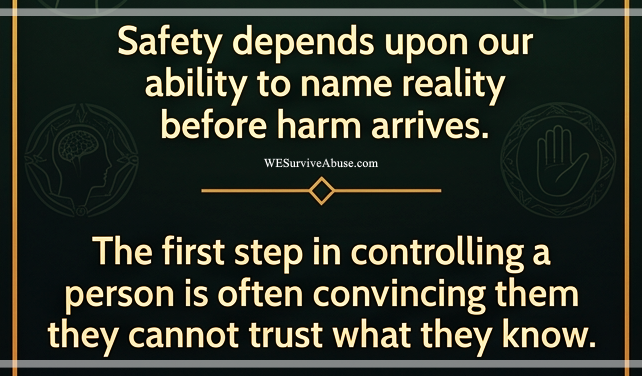
One of the most effective ways to control people is convincing them they cannot trust their own judgment.
When a woman is repeatedly told she is overreacting, imagining things, being emotional, or misunderstanding events, she may begin questioning her own perceptions.
13. She Is Trying to Leave Safely
Many women know that the most dangerous time can be when a person is losing control over them.
Sometimes silence is part of a larger safety strategy.
14. She Knows Some People Become Angry When Rejected
Women are often taught safety rules that men rarely have to consider.
Watch your drink.
Check your surroundings.
Text someone when you get home.
Don’t walk alone.
Have an exit plan.
Many of those rules exist because women understand that rejection can trigger unpredictable reactions from some individuals.
15. She Is Prioritizing Survival
There are moments when a woman is not asking herself, “How do I make my feelings known?”
She is asking herself, “How do I get home?”
“How do I stay alive?”
“How do I protect my children?”
“How do I make it through tonight?”
Those are very different questions.
The Truth We Need to Remember
A woman’s silence is not proof of comfort.
It is not proof of agreement.
It is not proof of consent.
Before asking why she didn’t speak up, a better question may be:
Did she feel safe enough to speak up?
A society that values women’s choices must care about more than whether women have a voice.
It must care whether women can use that voice without fear.
Because silence is not always permission.
Sometimes silence is survival.