Table of Contents
“Will a highly neutral parentage framework be sensitive enough to recognize unequal power, violence, coercion, reproductive abuse, and sexual assault?”
If institutions are going to look women in the face and demand we replace the sacred title of “Mother” with the clinical term “birthing person,” then let’s be logically consistent.
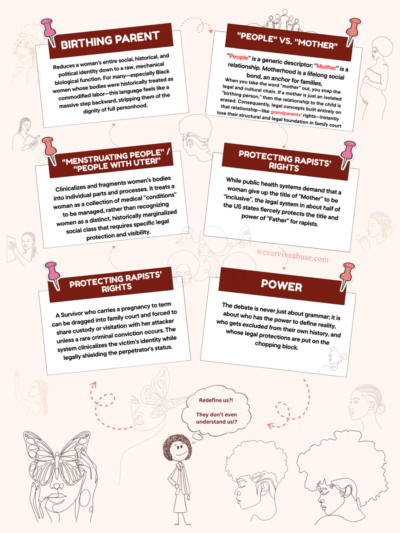
A mother is not a medical condition—she is a relationship. If we are going to sanitize human relationships out of the vocabulary and reduce parenthood to raw biological labor, then the entire legal and social house needs to tumble down with it. When you replace “mother” with “people,” you strip away her specific, sacred connection to her child.
If institutions are going to strip away the word “mother” and replace it with a cold, detached medical function, then the ripple effect breaks everything. A mother isn’t just someone who experiences a bodily condition; she is in a foundational relationship with the child. If you turn motherhood into a generic state, you compromise the entire legal and social structure built around family relationships—including grandparents, who derive their legal standing entirely through the recognized mother or father.
If you strip it from the mother, here are the 6 things that better ripple and change right along with it:
1. No More “Grandparents”
If there is no recognized mother, then there is no recognized grandmother or grandfather. You can’t have a multi-generational branch if you chop down the trunk of the tree. Let’s wipe out “grandparents’ rights” from the family court system entirely and start calling them “secondary genetic lineage contributors.”
2. Abolish the Title of “Father”
Why does the male identity remain completely intact while ours is fragmented? If women are “birthing people,” then fathers must immediately become “inseminating individuals” or “sperm-providing persons.” You don’t see public health campaigns targeting “prostate-owning people,” because the system respects men’s boundaries. If you strip our title, strip theirs too.
3. Dissolve the Legal Family Unit
The entire legal framework of custody, inheritance, and family law is built on recognized parental relationships. If we reduce motherhood to a mere clinical event, then the family unit is dissolved into a collection of detached individuals. We are stripping away the very emotional and moral anchors that hold communities together.
4. Strip Parental Rights from Rapists
This is the most infuriating double standard of all. Right now, in about half the states in this country, a rapist still retains his parental rights unless he faces a rare criminal conviction. A Survivor can be dragged into court, forced to share custody, or made to track down her attacker just to get a signature for adoption.
Did you know? In some states, if a Survivor wants to place the baby up for adoption, the law requires her to track down her rapist to get his legal signature and consent to terminate his rights.
Think about the sickness of this: institutions will aggressively police a woman’s vocabulary to take away her title of “Mother,” while the legal system fiercely protects the title of “Father” for a violent criminal. If relationship doesn’t matter, strip his rights instantly.
The nightmare breaks down into two main legal traps across the country:
1. The “Criminal Conviction” Trap (25 States)
In exactly half the states, a rapist’s parental rights can only be permanently severed if he is criminally convicted of the rape.
Think about how high that wall is. The Department of Justice’s own data shows that out of every 100 rapes, only about 25 are ever reported to police, only about 5 lead to an arrest, and less than 1 results in a felony conviction. If a Survivor doesn’t report out of fear or trauma, or if the prosecutor drops the case, the rapist retains his full rights to sue for custody or visitation. He can force her into mediation, demand family court hearings, and use the child to continue terrorizing her for 18 years.
2. The “Civil Court” Evidentiary Battle (25 States)
In the other half of the country, state laws allow a survivor to petition a family court judge to strip the rapist’s rights without a criminal conviction. But the burden is entirely on her. She has to hire a lawyer and prove by “clear and convincing evidence” in a civil court that the child was conceived via sexual assault. She is forced to litigate her own assault in a family court room just to protect her baby.
The Ultimate Extortion: The Adoption Block
It gets even worse. If a Survivor decides that the best path for her healing and the baby’s future is to place the child up for adoption, the legal system throws up a massive roadblock.
Because the biological father’s rights are protected by default, the adoption cannot go through without his consent or a formal termination of his rights. In states across the country, advocates have documented cases where rapists actively threaten to block an adoption—demanding custody instead—unless the victim agrees to drop criminal charges or stay quiet.
This is the exact reason why the “birthing people” debate feels like a twisted distraction. While institutions are actively spending time policing women’s vocabulary to ensure medical charts are de-sexed, the actual legal framework of this country is fiercely protecting the status, power, and parental rights of rapists over their victims.
Think about the sheer weight of what a woman or girl goes through in that scenario: she endures the trauma of an assault, carries the pregnancy, goes through the intense physical toll of labor, and steps into the lifelong emotional reality of motherhood—only for the system to treat her attacker’s biological contribution with the exact same legal weight.
It feels like the ultimate betrayal. The system will look at a Survivor and say, “We are going to police your language, take away your title as a mother, and treat your identity like a sterile, clinical condition,” while simultaneously turning around to a violent criminal and saying, “Your status as a father is sacred and legally protected.”
5. Erase the History of the Black Mother
For Black women, “Mother” is a title that was fought for and won over generations of survival and resistance against a system that treated them as mere reproductive commodities. Removing children from their mothers randomly and at-will. To replace “Mother” with a generic, sterile descriptor like “people” sanitizes history. It erases the distinct social class of women and dilutes the focus needed to fight the actual systemic racism causing the Black maternal health crisis.
6. Good-bye to Grandparents’ Rights in Family Court
Let’s look at the legal reality: in all 50 states, grandparents can petition for visitation or custody under specific circumstances (like divorce or the death of a parent). But legally, grandparents’ rights only exist because the child’s mother or father exists. The law traces the family line through the parents. If you destroy the legal definition of a mother and turn her into an isolated “birthing unit,” you snap the legal chain. You instantly wipe out a grandmother’s right to stand in front of a family court judge and fight to see her grandbaby.
Systems often perform best when everyone is acting in good faith. They struggle when one person is using the system itself as a weapon.
A custody form cannot tell the difference between:
- a loving father,
- a rapist,
- a coercively controlling ex-partner,
- a stalker,
- or a man using the child to maintain access to the mother.
That is why many Survivor advocates focus less on the terminology itself and more on questions such as:
- Are there strong rape-parentage protections?
- Can parental rights be terminated without requiring a criminal conviction?
- Are pregnant women screened for coercion and abuse?
- Can hospitals provide confidential safety planning?
- Can family courts recognize coercive control?
- Can women safely oppose parentage claims without retaliation?
Those are often the places where women’s safety is won or lost.
One critique that some women’s advocates make is that if lawmakers spend enormous energy redesigning parental language but insufficient energy addressing maternal homicide, rape-related pregnancy, reproductive coercion, and abusive litigation, then women may reasonably ask whether the system is prioritizing the right problems.
The Bottom Line: You cannot divorce language from human dignity. A mother is a mother. It is a lifelong, sacred relationship—and our linguistic sovereignty is not up for negotiation.
But it goes way deeper than a double standard. A mother is not a medical condition. A mother is a relationship. You look around and no one else is being pushed to change their language relationship to the child but …..mothers.
As states modernize family law language, what protections are they building for women who are pregnant because of rape, coercion, trafficking, or abuse?
Everyone should be who they are and that must always include the human beings who birth other human beings….women.