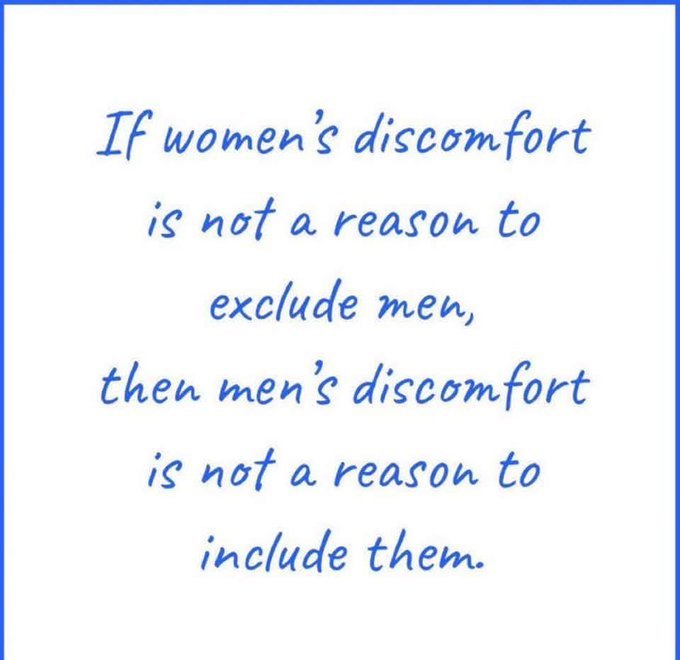
There is a difference between allowing another human being freedom and requiring somebody else to participate in that person's understanding of themse
There is a difference between allowing another human being freedom and requiring somebody else to participate in that person’s understanding of themselves.
We blur those two things far too easily. 
An adult wearing particular clothing requires nothing from me. A hairstyle requires nothing from me. Makeup requires nothing from me. Someone changing a name does not require me to surrender my privacy, my body or my physical safety.
But institutions can move the situation beyond personal expression.
That is where women are allowed to ask questions.
👗 1. Clothing Is Personal Expression
A man wearing a dress does not take anything away from me.
Neither does long hair, makeup, jewelry, mannerisms or interests traditionally associated with women.
Women ourselves have spent generations fighting stereotypes about what female human beings are supposed to wear, enjoy and look like.
Freedom from those stereotypes should mean more freedom for everybody.
🚪 2. Entering a Sex-Separated Space Is Something Different
A women’s prison is not a dress.
Neither is a women’s shelter, changing room, or communal shower.
These arrangements involve other human beings. Their bodies, privacy, histories, vulnerabilities and sometimes their inability to leave become part of the equation.
Now more than one person’s liberty is involved.
🏛️ 3. An Institutional Classification Is Not a Personal Feeling
Institutions classify human beings all the time.
Medicine does it. Prisons do it. Sports organizations do it. Researchers do it. Governments do it.
Those classifications can have consequences.
Once an institution changes a classification, that decision can determine who shares facilities, who competes against whom, how statistics are recorded, how searches are conducted and what language employees or members of the public are expected to use.
That is no longer entirely private.
🗣️ 4. Language Can Require Participation Too
Courtesy is one thing.
Institutional requirements are another.
Consider the difference between someone saying:
“I would like you to call me this.”
and an institution saying:
“You are required to describe this person this way.”
The first person is making a request about interpersonal treatment.
The second is an authority establishing rules governing somebody else’s speech.
Those are different exercises of power.
⚖️ 5. Tremaine Carroll Gave Us an Unusually Clear Example
The Tremaine Carroll rape prosecution brought this distinction directly into a courtroom.
Carroll is a male prisoner who identifies as a woman and had been transferred into California’s Central California Women’s Facility. Carroll was subsequently charged with raping female prisoners and has denied the allegations.
During the criminal proceedings, the court addressed how prosecutors could refer to Carroll. Prosecutors objected to using female pronouns, arguing that doing so could confuse their presentation of a rape prosecution involving female alleged victims.
That wasn’t an argument about whether Carroll could wear women’s clothing.
It was an argument about what other people could be required to say while attempting to describe an alleged sexual assault.
👩🏾 6. Now Put the Woman Back Into the Picture
Imagine what institutional participation can mean from her side.
She may be asked to share a sex-separated environment based upon an institutional classification she does not share.
She may be expected to use language based upon that classification.
She may be expected to disregard sex when the institution considers gender identity controlling.
And depending upon the rules of the institution, objections may carry social, professional or disciplinary consequences.
Whatever conclusion someone reaches about those policies, this is considerably more than allowing another person to live freely.
The woman is being asked to do something too.
🔄 7. Sometimes We Discuss Only One Person’s Autonomy
This is where the conversation can become strangely lopsided.
We talk about one person’s freedom of identity.
One person’s freedom of expression.
One person’s dignity.
One person’s need for recognition.
But the moment another human being is required to participate, there are two people in the ethical equation.
Women are human beings in that equation too.
🧠 8. Recognition Cannot Require Women to Deny Their Own Perception
Human beings notice sex.
We have done so across cultures and throughout human history. Women in particular have sometimes depended upon distinguishing males from females when making decisions about privacy, intimacy and personal safety.
An institution can establish terminology.
It cannot make women incapable of observation.
And when women describe what they observe, treating the observation itself as wrongdoing creates another problem rather than resolving the original disagreement.
🔒 9. Sex Can Carry Information Women Use to Make Decisions
Sex is not relevant to every interaction.
I don’t need to know someone’s sex to stand beside that person in a grocery-store line.
But context changes things.
A prison cell is different from a grocery store.
A communal shower is different from a sidewalk.
A sexual encounter is different from a conversation.
A medical examination is different from sharing an elevator.
The more intimate the boundary, the more difficult it becomes to argue that another person’s classification automatically overrides a woman’s own assessment of who enters it.
❤️ 10. Romantic and Sexual Choice Makes the Difference Even Clearer
Adults have enormous freedom to present themselves as they wish.
But another adult has equally enormous freedom over romantic and sexual selection.
Nobody possesses a right to be included in somebody else’s dating pool.
If a fact is deliberately concealed or falsely represented specifically because someone believes knowing the truth could cause the other person to refuse romantic or sexual participation, we have moved into a serious conversation about deception and informed choice.
Personal freedom cannot mean controlling the information another human being uses to decide what happens with her own body.
🏢 11. Institutions Can Turn Courtesy Into Compliance
This is the part I want women to be able to examine without shame.
Sometimes institutions do more than encourage kindness.
They establish classifications.
They write policies.
They create disciplinary rules.
They determine who enters spaces.
They decide which words appear in official records.
They determine which objections are considered legitimate.
At that point, we are no longer discussing whether people should be cruel to somebody who is different.
We are discussing institutional power.
🔍 12. Ask What Participation Is Actually Being Required
This question can clarify a surprising amount:
What does respecting this person’s freedom require another person to do?
Does it require nothing?
Fine.
Does it require ordinary courtesy?
That can be discussed.
Does it require another person to surrender privacy?
Now something has changed.
Does it require someone to accept physical proximity she would otherwise decline?
Something has changed again.
Does it require her to alter how she describes another person’s sex?
That is another demand.
Does it require her to provide romantic or sexual access she would refuse if she possessed different information?
We have crossed into bodily autonomy.
These aren’t interchangeable situations.
🌿 13. Women Do Not Have to Choose Between Cruelty and Compliance
There is another possibility.
We can support people’s freedom to dress as they please without abolishing women’s freedom of association.
We can oppose harassment without requiring women to surrender boundaries.
We can protect transgender prisoners from violence without pretending female prisoners have no legitimate safety interests.
We can treat people with dignity without making women’s perceptions, language and boundaries available for institutional revision.
That isn’t contradictory.
It recognizes that liberty belongs to more than one person.
🪞 14. The Question Institutions Rarely Put on the Form
Whenever an institution announces a new accommodation, classification or inclusion policy, there is another question sitting quietly underneath it:
Who is required to accommodate whom?
Then come the questions behind that one.
Who changes?
Who shares?
Who loses privacy?
Who changes language?
Who assumes additional risk?
Who can object?
Who cannot leave?
And whose objection becomes the problem the institution decides it needs to solve?
Those answers tell us considerably more about equality than the language printed across the top of the policy.
Personal expression belongs to the individual.
But when institutions require other human beings to alter their speech, surrender privacy, accept physical proximity, disregard information they consider relevant or change their own boundaries, something different is happening.
Freedom is no longer being requested only for one person. Participation is being requested from another.
Women are allowed to examine the difference.
When Propaganda is Used Against Abuse Survivors – WE Survive Abuse
There Is No Bad Day to Tell the Truth – WE Survive Abuse
Green Flag: Safe Adult Males Stay Out of Female Spaces and Advocate for It – WE Survive Abuse
Not All Submission Looks Like Sunday School – WE Survive Abuse
The Burden of Blindness: How Systems Force Us to Ignore Our Own Reality – WE Survive Abuse
🛑 What Is a Boundary? (And Why It’s Not a Punishment) – WE Survive Abuse
Facing Reality: Identity Does Not Erase Patterns of Male Violence – WE Survive Abuse
“Why Are Women Still Cleaning Up the Violence Men Refuse to Name?” – WE Survive Abuse