updated from November 5, 2022 "You know good and well that a boundary never did a damn thing to you. But a male has every potential to AND be excus
updated from November 5, 2022
“You know good and well that a boundary never did a damn thing to you.
But a male has every potential to AND be excused for doing it.
Because he is a male.
Tale as old as time.”
Tonya GJ Prince
We are living through a time when children—especially girls—are being taught something deeply dangerous:
That having boundaries is “hate.”
That discomfort is “hate.”
That asking questions is “hate.”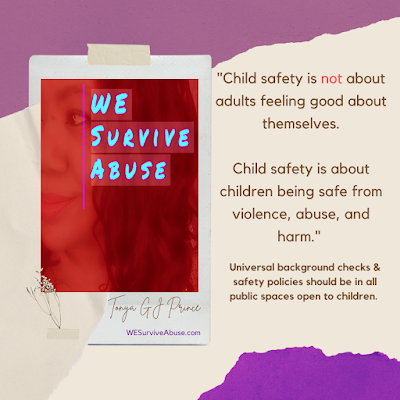
And that girls should silence their instincts in order to prove they are “good” or “inclusive.”
That lesson is not kindness.
It is conditioning.
And it puts girls at risk.
Girls Are Being Told to Override Their Own Safety Instincts
Across schools, online spaces, and public conversations, many girls are receiving the same message:
If you feel uncomfortable, you are the problem.
If you question a situation that involves privacy, nudity, or personal space, you are hateful.
If you want to understand what is happening so you can assess your safety, you are intolerant.
In other words:
No questions allowed.
Just be quiet and deal with it.
For any child—especially a girl learning to navigate the world—this is an extremely dangerous lesson.
Safety begins with awareness.
Awareness begins with questions.
Discomfort Is Not Hate
Even in traditional spaces like locker rooms, many girls and women have never felt fully comfortable being partially or fully nude around others.
That reality has always existed.
Some women are modest.
Some have experienced past violations.
Some simply prefer privacy.
None of that is hatred.
The expectation that women and girls must feel comfortable being partially nude, fully nude, or emotionally exposed in front of another person—no questions asked— is not compassion.
It is coercion.
When someone demands your comfort without your consent, that is not inclusion.
That is pressure.
And pressure around bodies and boundaries has always been a warning sign.
This Pattern Is Not New
History is full of moments where girls were told:
Don’t question authority
Don’t make others uncomfortable
Don’t create conflict
Don’t embarrass anyone
In other words: don’t defend yourself.
Millions upon millions of women carry memories of what happened when their discomfort was ignored, dismissed, or mocked.
That is why teaching girls to trust their instincts matters so deeply.
Preparing Girls for Reality
When I posted about this topic online, another woman raised an important point:
There has always been resistance when girls begin to set boundaries.
Girls who say “no” are often labeled difficult.
Girls who ask questions are labeled rude.
Girls who protect themselves are labeled hateful.
This pattern has existed for generations.
Which means our responsibility is clear.
We must prepare girls for it.
What Girls Need to Know
Girls deserve to grow up knowing:
Their safety instincts are valuable.
Discomfort is information, not wrongdoing.
Questions are part of protecting themselves.
Boundaries are healthy.
Their bodies belong to them.
Most importantly:
They must know that safe adults will stand with them when they say no.
Real Diversity Does Not Erase Boundaries
Authentic diversity does not require people to abandon their values, beliefs, or sense of safety.
Real diversity brings people with different beliefs and experiences into shared spaces with respect.
Harmony does not mean takeover.
And inclusion does not mean that girls must surrender their privacy, dignity, or bodily autonomy.
Women and girls are entitled to boundaries wherever they live their lives:
In schools
In locker rooms
In doctor’s offices
In workplaces
In their homes
In their communities
Health and safety are not negotiable privileges.
They are basic human rights.
A Difficult Truth
Some of the strongest enforcers of diminished boundaries for women and girls are sometimes other women.
That reality is painful.
But it is also understandable.
Many people have been taught for years that silence is kindness and that compliance is virtue.
Some have been conditioned so effectively that they now believe defending girls’ boundaries is wrong.
Even so, the responsibility remains the same.
Protect girls anyway.
Teach them anyway.
Stand with them anyway.
Because every generation of girls deserves to grow up knowing something simple and powerful:
Their safety matters.
Their dignity matters.
And their “no” is enough.
Am I Selfish for Setting Boundaries? (audio) | WE Survive Abuse
Sex-Based Bill of Rights for Women and Girls (FREE download) | WE Survive Abuse
18 Signs You May Not Be as Pro-Woman as You Believe You Are | WE Survive Abuse
How Male Violence Taught Women & Girls to Attack One Another (audio) | WE Survive Abuse