
“If your confidence turns out to be misplaced, what protections exist for the people expected to absorb the consequences?” When certainty replaces
“If your confidence turns out to be misplaced, what protections exist for the people expected to absorb the consequences?”
When certainty replaces preparation

Photo by Karthick Krishnakumar
We have all heard it:
“Nothing will happen.”
“There is no risk.”
“You’re worrying about nothing.”
But safety is never built on reassurance alone.
Safety is built on structures that function when reassurance fails.
Whether it is a very sure supervisor, neighbor, relationship partner, friend, relative, political leader, or political candidate.. It is always okay to ask about their backup plan. Here’s a phrase that might work and you can feel free to use your own word choices.
This is not fear.
This is responsible thinking.
History is filled with important moments when concerns were minimized. Just look at the place where you work. The reason that the handbooks occupy several shelves, you sign all those documents, and trainers come in routinely likely has something to do with ordinary people’s concerns being minimized somewhere in the past.
Back then, it was framed as “overreaction”.
Someone was “harmed.”
Responsibility tried to run for the hills.
And here we are today.
Still, it was always “unforeseeable”. “No one could seen it coming”
Nearly always, someone saw it coming and no one wanted to hear it.
What real safeguards look like
Real safeguards are not, “here let me tell you good little girls what a nice girl does“. Real safeguards are not people with power sitting rolling out the plan in a visual show force.
Safeguarding a mutual agreement. I like meetings where BOTH parties sign agreements that neither felt pressured to.
1. Clear Accountability
If harm happens:
Who responds?
Who investigates?
Who decides outcomes?
Who tracks patterns?
Without accountability, “safety” is a slogan.
2. Explicit Boundaries
Are expectations defined?
Privacy rules
Behavioral standards
Definitions of violations
Consistent consequences
Ambiguity protects systems.
Clarity protects people.
3. Immediate Response Options
When someone feels unsafe:
Can they leave immediately?
Can they report without backlash?
Is support accessible right away?
Safety delayed often becomes safety denied.
4. Protection From Social Punishment
Can people raise concerns without:
Labeling
Character attacks
Institutional defensiveness
When speaking up is punished, silence becomes predictable.
5. Periodic Re-Evaluation
Do leaders ask:
“What are we seeing in reality?”
“What feedback are we receiving?”
“What near-misses occurred?”
What is never reviewed is never corrected.
6. Exit Without Stigma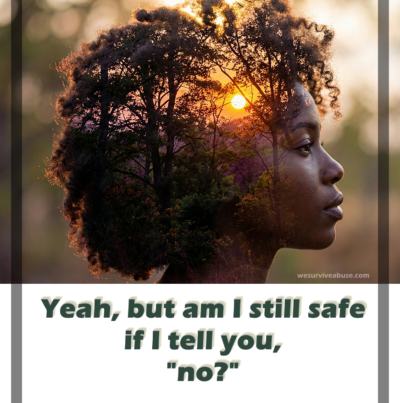
Can individuals say:
“This doesn’t work for me”
“I need a different arrangement”
“I prefer another option”
Choice is not rejection.
Choice is autonomy.
A grounding truth
Safety is not proven by confidence.
Safety is proven by preparedness for the moment confidence is wrong.
It is okay to change your mind, and if EVER it is not…….RUN!
Affirmations Inspired by Women Who Refused to Shrink
1.I honor the women who stood their ground, spoke their truth, and lived fully — and I carry that inheritance forward.
2.
My boundaries are not cruelty.
They are clarity.
They are self-respect in visible form.
3.
I do not measure my worth by how comfortable others feel with my strength.
4.
Like the women before me, I define my life from the inside out — not from expectation, pressure, or stereotype.
5.
I release the burden of being “pleasant” at the cost of being safe, honest, or whole.
6.
My independence is not rebellion.
It is a natural expression of my humanity.
My responsibility is honesty and respect — not endless availability.
Each boundary I honor strengthens my self-trust, my peace, and my emotional clarity.
I can be warm, compassionate, and kind without surrendering my voice, instincts, or authority over my own life.
I embrace humor, intelligence, softness, and power — knowing no single role contains me.
I refuse narratives that reduce women to stereotypes, punchlines, or supporting characters in their own stories and opportunities.
I am allowed to take up space without softening my truth to make others comfortable.
I honor the wisdom of my instincts; they exist to protect me, not to be negotiated away.
My boundaries are a reflection of my self-respect, not a rejection of others.
I am allowed to maintain boundaries even with people I love, people I’ve known forever, and people who expect unlimited access.
I release the belief that keeping the peace requires me to betray myself.
Healthy relationships are not built on my self-erasure, but on mutual respect for limits, needs, and dignity.