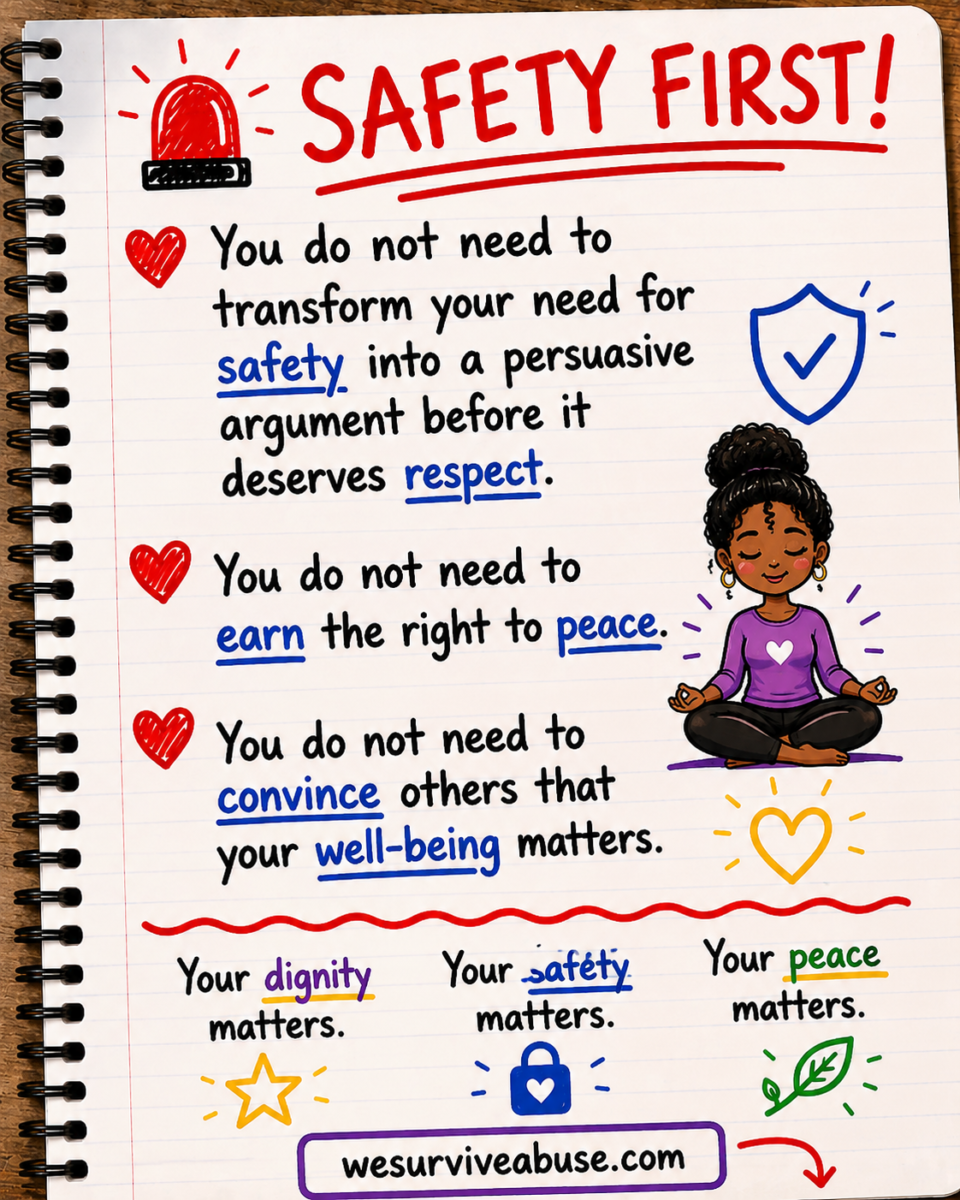
A woman asks for safety. Everyone else asks for evidence. 🌿 Sometimes a woman is not asking for much. She is asking for rest.Sh
A woman asks for safety.
Everyone else asks for evidence.
🌿 Sometimes a woman is not asking for much.
She is asking for rest.
She is asking for privacy.
She is asking for space.
She is asking for peace.
She is asking for the freedom to make decisions about her own life without turning those decisions into a public hearing.
Yet somehow, the conversation shifts.
Suddenly she is explaining.
Then defending.
Then persuading.
Then proving.
Then debating.
Then wondering why something as simple as her need for safety has become a topic for negotiation.
After more than thirty years working alongside Survivors, I have noticed something that rarely gets discussed openly.
Many women are taught that their boundaries require explanations.
Many women are taught that their safety requires evidence.
Many women are taught that their “no” requires approval.
🌻 And that is where coercion often begins.
What Is Forced Access?
Forced access is a phrase I use to describe something many Survivors recognize immediately, even if they have never heard the term before.
Researchers often discuss these behaviors through the lens of coercive control, stalking, harassment, post-separation abuse, and boundary violations. The common thread is that one person continues seeking access after another person has clearly communicated a need for distance.
When I think about forced access, I think about what happens when someone refuses to accept space.
A woman says:
“I need some distance.”
The response is:
“Why?”
She explains.
Then comes another question.
Another challenge.
Another debate.
Another demand.
Before long, the original boundary is buried beneath a mountain of explanations.
🍃 That is the moment many women recognize.
The conversation was never really about understanding.
The conversation became about maintaining access.
Respect Versus Access
Healthy people generally respond to boundaries with respect.
Controlling people often respond to boundaries with negotiation.
A healthy person may ask a question and then honor the answer.
A controlling person treats the answer as the beginning of a campaign.
A healthy person looks for solutions.
A controlling person creates more interaction.
A healthy person respects distance.
A controlling person searches for ways around it.
Many Survivors describe feeling like they are standing at a doorway trying to close it while someone else keeps pushing it back open.
🚪 Every explanation becomes another opportunity to step inside.
Understanding Versus Justification
This distinction changed the way I looked at many situations.
Understanding says:
“Help me understand what you need.”
Justification says:
“Convince me your need is legitimate.”
Those two approaches may sound similar.
They are not.
One begins with respect.
The other begins with skepticism.
Women often find themselves trapped in endless cycles of justification.
Why do you need space?
Why are you uncomfortable?
Why did you leave?
Why won’t you answer?
Why won’t you meet?
Why won’t you explain?
Months pass.
Sometimes years.
Meanwhile the original concern gets lost.
🌱 Safety becomes secondary to someone else’s demand for access.
When Every Incident Looks Small
One reason coercive control is so difficult for outsiders to recognize is that individual incidents often appear harmless.
It is just a text message.
It is just a phone call.
It is just a meeting request.
It is just a court filing.
It is just a social media message.
It is just one more conversation.
Yet Survivors are often responding to the accumulation of hundreds of incidents, not a single event.
Most people focus on one brick.
The Survivor sees the wall.
🧱🧱🧱🧱🧱
A text message.
A surprise visit.
A demand for explanation.
A reopened argument.
A rejected boundary.
Separately they may appear insignificant.
Together they can create a system of pressure that steadily erodes freedom, privacy, peace, and autonomy.
The pattern often looks like this:
Boundary → Request for Distance → Demand for Explanation → Debate → More Contact → More Justification → More Access
The cycle continues until the person at risk decides they no longer need permission to honor their own well-being.
Why Women Become Exhausted
I have spoken with women who could recite every detail of a harmful relationship.
Every conversation.
Every concern.
Every incident.
Every fear.
They became experts in presenting evidence.
What broke my heart was realizing how much of their lives had been spent trying to convince others that their needs mattered.
😔
A woman should not need a PowerPoint presentation to justify her peace.
A woman should not need a committee vote to decide who has access to her life.
A woman should not have to perform her pain for public review before people respect her boundaries.
Yet many women learn that the moment they explain themselves, the explanation becomes material for criticism.
Sometimes it becomes gossip.
Sometimes it becomes ridicule.
Sometimes it becomes a joke.
Sometimes it becomes evidence used against them.
And then comes the familiar question:
“Why didn’t she leave?”
A question that often ignores how much time, energy, money, emotional labor, and courage she already spent trying to convince others that she needed protection in the first place.
Sometimes I think we ask women to become attorneys for their own humanity.
As though dignity is something awarded after a successful presentation.
As though peace requires approval.
As though safety is granted only after enough people are persuaded.
That is a heavy burden.
And it creates a dangerous opening.
Because while a woman is busy proving she deserves safety, someone else may be busy demanding continued access to her life.
Research Sources Used