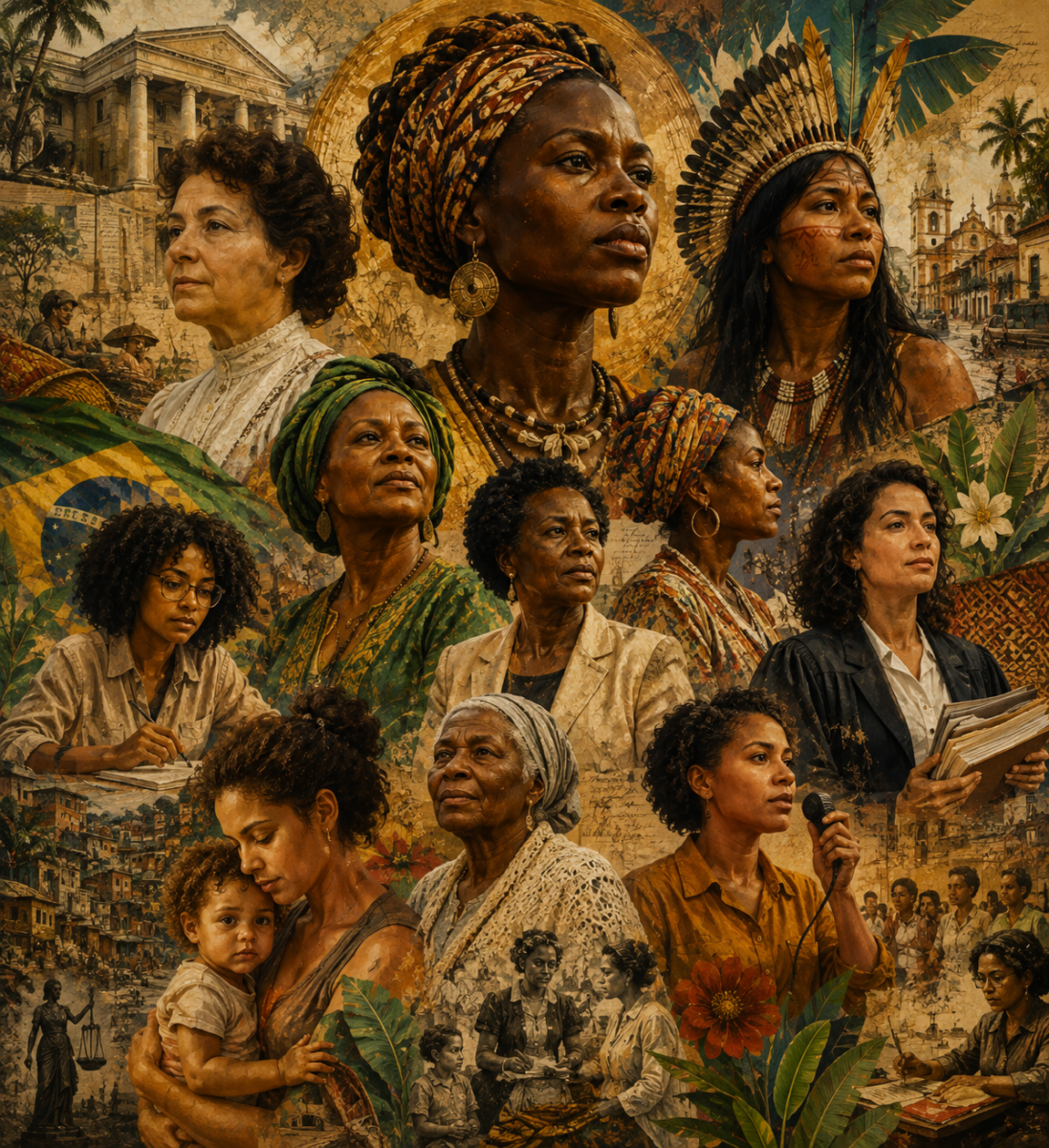
Beautiful Brazil. A country that, like many others, has a long way to go when it comes to how it treats the women and girls who are its citizens. Wo
Beautiful Brazil. A country that, like many others, has a long way to go when it comes to how it treats the women and girls who are its citizens.
Women are battling for the right to speak truth. And we’re going to talk about the two recent cases involving a law around “misgendering” men. But before we do, it is important to take a look at the landscape of social hurdles that block the progress of women and girls.
If the law can determine when a woman may speak truthfully about a man’s self-identification, what prevents that principle from expanding into other areas where women’s voices matter?
Meanwhile, these legal battles require women to spend time, money, and emotional energy defending themselves for speaking about men, sex, or boundaries. That alone deserves attention.
Laws are rarely only about one case. They establish principles.
And principles often reach further than anyone first imagines.
If a woman can face legal consequences for describing a man according to the facts of biological sex, it is reasonable to ask where that principle begins, where it ends, and which women will bear its greatest burdens.
It also raises a broader question: when the law begins defining what women and girls may or may not say about a man based on his beliefs or identity, what principle limits where that authority ends? Why should we assume it would stop there? What other truths will women be legally restricted from speaking?
Sometimes the greatest test of a legal system isn’t who it protects. It’s who quietly carries the greatest burden while everyone else debates the law.
When laws change, we often ask whether they are fair.
That’s an important question.
But there is another question history encourages us to ask:
Which women bear the greatest burden under this law?
The answer is rarely “all women equally.”
Across Brazil, some women carry heavier legal, economic, and social burdens than others—not necessarily because the law was written to harm them, but because they have fewer resources, less political influence, or greater barriers to justice.
Looking at these women helps us understand not only Brazil, but a broader truth about how legal systems operate.
1. Poor Women Often Carry the Greatest Burden
A legal right means little if you cannot afford to exercise it.
Travel.
Legal representation.
Time away from work.
Transportation.
Childcare.
Private healthcare.
For women living in poverty, every legal process costs more.
Justice often becomes something wealthier women can reach more easily.
Legacy Lens
A law should be judged not only by what it promises, but by whether ordinary women can actually use it.
2. Rural Women May Have Rights They Cannot Reach
Healthcare.
Courts.
Shelters.
Police.
Specialized services.
On paper, they exist.
In practice, some women must travel hours to reach them.
Distance becomes another legal burden.
A right that cannot be reached is only partially a right.
3. Disabled Women Face Barriers Beyond the Law
Some women cannot easily access:
police stations
emergency hotlines
courts
transportation
healthcare
information
Others depend on the very people harming them.
The law may promise protection.
Accessibility determines whether protection becomes reality.
4. Mothers Sometimes Carry the Burden of Being Disbelieved
When mothers report abuse, raise concerns about custody, or try to protect children, they may find themselves defending their own credibility.
The conversation can shift from:
“Is this child safe?”
to
“Is this mother exaggerating?”
Sometimes protecting children requires protecting the women who speak for them.
5. Girls Often Carry Burdens Adults Created
Girls rarely create the circumstances that place them at legal risk.
Yet they often bear the consequences.
Child marriage.
Sexual violence.
Educational interruption.
Teen pregnancy.
Dependency.
The youngest girls frequently possess the least power while carrying some of the greatest burdens.
6. Women With Unpopular Views May Become Legal Test Cases
Some women become the first to challenge—or be challenged by—new interpretations of law.
Recent Brazilian cases involving speech and gender identity have raised questions about the relationship between anti-discrimination protections, freedom of expression, and women’s ability to speak about biological sex.
Reasonable people disagree about where those legal boundaries should be drawn.
Regardless of one’s position, these cases illustrate a broader truth:
Legal transitions are often experienced first by individual women whose cases become public debates.
History remembers the ruling.
It often forgets the woman living through it.
7. Black and Indigenous Women Often Carry Multiple Burdens at Once
Law is never experienced through only one identity.
Many Black, Indigenous, Quilombola, and other historically marginalized women navigate overlapping challenges related to healthcare, housing, employment, education, transportation, and access to justice.
The burden is not simply racial.
It is cumulative.
Every additional barrier makes every legal right more difficult to exercise.
8. Obstetric violence
Brazil has been criticized internationally for:
unnecessary cesarean sections
abusive childbirth practices
non-consensual procedures
verbal abuse
Research indicates Black women may experience worse treatment.
This is another place where women meet institutions at their most vulnerable.
9. Quilombola women
This is fascinating history.
Quilombolas are descendants of communities founded by escaped enslaved Africans.
Brazil recognizes certain collective land rights.
However, many Quilombola communities have spent decades fighting for formal land titles.
Women in these communities often become leaders defending land, food systems, and culture.
Delayed land recognition affects:
inheritance
farming
education
economic independence
10. Housing and land rights
Many Afro-Brazilian women living in favelas face:
insecure housing
forced evictions
limited sanitation
violence
Again…
The law rarely says:
“Black women cannot…”
Instead, legal systems fail to adequately secure their communities.
11. Police violence affects Black mothers
Brazil’s policing practices have disproportionately affected Black communities.
While this is often discussed as a race issue, from a female lens there is another dimension.
Black mothers frequently become:
caregivers of injured children
advocates for sons killed by police
women navigating the justice system
heads of households after deaths or imprisonment
Women carry enormous invisible legal burdens created by policing.
12. Domestic workers were excluded from many labor rights for decades
This is one of the biggest.
For generations, domestic work—performed disproportionately by Black women—was excluded from many of the labor protections enjoyed by other workers.
Until a constitutional amendment in 2013 and later implementing legislation, many domestic workers lacked rights such as:
overtime pay
unemployment insurance
limits on working hours
mandatory severance protections
other employment benefits
Why does this matter?
Because after slavery, domestic service became one of the few occupations widely available to Black Brazilian women.
A labor law that undervalues domestic workers disproportionately harms Black women.
This is a classic example of a law that appears occupation-based but has profound racial and gender effects.
The Question We Should Keep Asking
When a society changes its laws, it is natural to ask:
Who benefits?
That matters.
But another question matters just as much.
Which women quietly carry the greatest burden so that everyone else can move forward?
Those women deserve more than sympathy.
They deserve our attention.
Because history often celebrates legal victories.
It less often remembers the women who absorbed the cost of reaching them.
What concerns me isn’t only one court case.
It’s the precedent.
Throughout history, women have fought to speak honestly about their bodies, their safety, and the behavior of men.
When legal disputes begin to define the boundaries of that speech, every woman has a stake in asking a careful question:
Who decides which truths women are permitted to speak—and what safeguards exist to prevent those limits from expanding?
Under Jim Crow in the United States, Black people were subjected to a racial etiquette system that controlled not only where they could go, but how they were expected to speak, address white people, carry themselves, and display deference. White adults were generally addressed as “Mr.,” “Mrs.,” or “Miss,” while Black adults were often denied those titles and called by their first names, “boy,” “girl,” “auntie,” or “uncle.” Black people were also expected to answer white people with deferential forms such as “sir” and “ma’am.
The state did not always need a law saying, “Use this word.”
It created and protected a hierarchy in which refusing the required language of deference could become dangerous.
Compelled or enforced language has historically been used to establish who must defer to whom.
Fast forward to today…..
A Brazilian woman was convicted and received a two-year sentence for statements that included deliberately referring to Duda Salabert as male, but she was not jailed at the time of sentencing, and the ruling remains subject to appeal.
Bianca Barreto, a Brazilian influencer. Reporting says that on July 29, 2026, a criminal court in Salvador convicted her after she used male terms for Salabert in a video. The court characterized the conduct as the intentional and derogatory use of a gender contrary to Salabert’s declared identity. She was sentenced to two years, ordered to pay R$20,000 in compensation, and may appeal. The sentence was reported as being served “in freedom,” meaning she was not incarcerated under that ruling.
Isabella Cêpa, a Brazilian feminist and graphic designer.
The basic timeline is:
In 2020, Cêpa referred to Brazilian politician Erika Hilton, a trans identified man, as a man in social media posts.
Hilton filed complaints with Brazilian authorities.
Brazil’s Supreme Federal Court had previously ruled (2019) that severe acts of homophobia and transphobia could be prosecuted under the country’s anti-racism law until Congress enacted specific legislation.
Cêpa became the subject of a criminal investigation and later stated she faced multiple counts under that legal framework. Some media reports described a potential maximum sentence of 25 years if convicted on all counts.
However, an important development followed:
In 2025, Brazilian authorities archived (closed) the specific federal case involving her after prosecutors concluded there was no specific criminal law that fit the conduct alleged in that case, and a judge held that her statements did not amount to criminal hate speech.
That history gives women legitimate reason to examine any rule that makes truthful or dissenting speech legally risky. The questions should be: Who controls the required language? Whose account of reality receives legal authority? Who is punished for refusing? And are women being required to subordinate their own descriptions of sex, boundaries, bodies, or safety?
If you believe in “resisting in advance”, then perhaps you can stop mobbing, slurring, and threatening women who practice it when it comes to men. All men.
Women and girls have the right to speak truth
How Many Times Must Women Be Told They Noticed Too Soon? – WE Survive Abuse
The Cage Looks Different, But It’s Still a Cage – WE Survive Abuse
Coercion in Disguise: When Love Asks You to Lie – WE Survive Abuse
🕊️ The Sisterhood Gag Order – WE Survive Abuse
When Belonging Breaks: Surviving in Truth When Cultures Defends Abusers – WE Survive Abuse