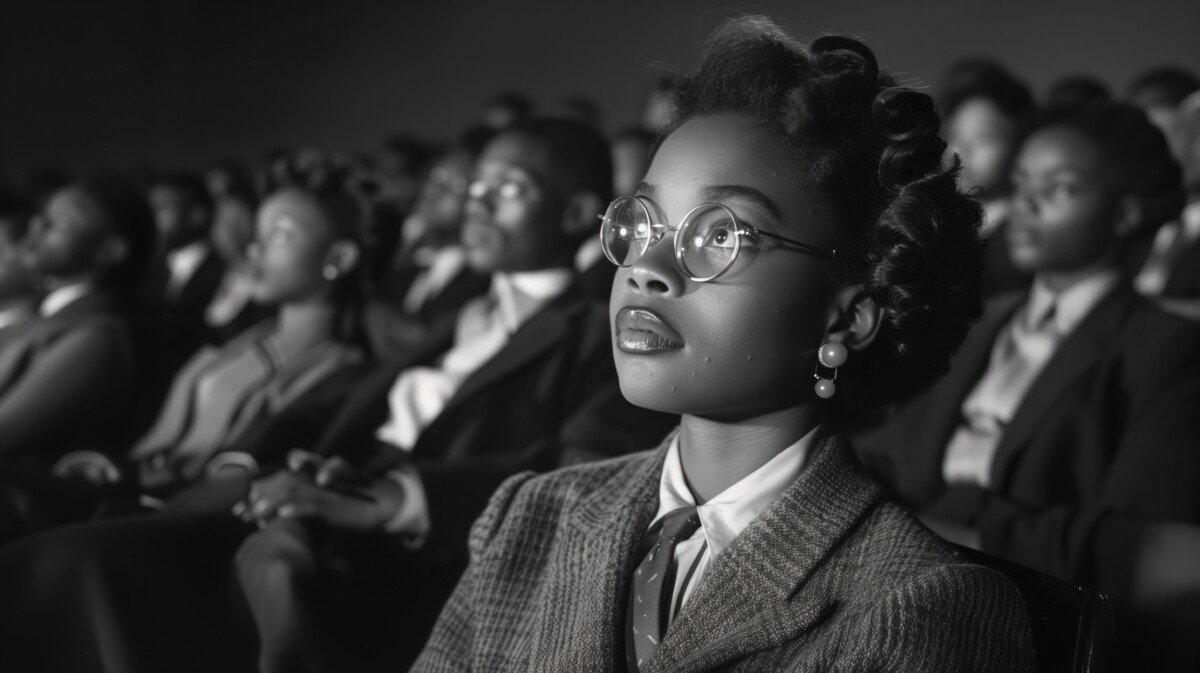
Black Americans have seen this rhythm before.There are periods when Black American faces, voices, and stories become highly visible.Film.
Black Americans have seen this rhythm before.
There are periods when Black American faces, voices, and stories become highly visible.
Film. Television. Music. Publishing. Advertising. Fashion. News. Sports. Awards.
Then the temperature changes.
Opportunities narrow. Certain conversations become less welcome. And suddenly people begin behaving as though Black American talent somehow disappeared.
It didn’t. Do not mistake a closed door for an empty room. Black American talent is ALWAYS in the building.
Black American actors did not suddenly become less gifted.
Black American writers did not forget how to write.
Black American directors did not lose their vision.
Black American musicians did not run out of sound.
Black American women did not become less beautiful, creative, intelligent, funny, charismatic or compelling.
Do not mistake a backlash for a lack of talent.
History Shows This Pattern Repeats
This rhythm — advancement followed by retrenchment — is not new. It has a documented history.
Reconstruction and Redemption (1865–1877 and after). After the Civil War, Black Americans were elected to state legislatures, to Congress, and to local office for the first time. Black-owned newspapers, schools, and businesses expanded rapidly. Then came the Redemption era: the withdrawal of federal troops after the Compromise of 1877, the rise of Black Codes and later Jim Crow laws, and a coordinated campaign of violence and disenfranchisement that erased much of that political progress within a generation.
The Red Summer of 1919. Black veterans returned from World War I having fought for a country that still denied them full citizenship. Black economic and cultural life was expanding in cities during the Great Migration. That same year, white mob violence broke out in dozens of cities — Chicago, Washington D.C., Elaine, Arkansas, and elsewhere — targeting Black communities, businesses, and returning soldiers.
The end of the Harlem Renaissance. Through the 1920s, Black writers, musicians, and artists produced an extraordinary flowering of literature, music, and visual art that reshaped American culture. When the Great Depression hit, funding, publishing opportunities, and mainstream attention contracted sharply. The talent did not vanish. The support did.
Post–Civil Rights backlash. The 1960s brought the Civil Rights Act, the Voting Rights Act, and visible gains in political representation and institutional access. In the years that followed, mass incarceration expanded, the War on Drugs disproportionately targeted Black communities, and what came to be known as the Southern Strategy sought political advantage by mobilizing racial resentment.
The Myth of Racial Harmony (1980s–2000s): What We Were Told to Forget – WE Survive Abuse
Post-Obama backlash. The election of the first Black American president in 2008 was followed by the birther movement, a rise in the visibility of explicit white nationalist organizing, and a sharpened political fight over how American racial history is taught and discussed.
The 2020s. Following the racial reckoning of 2020 — expanded hiring, greenlit projects, publishing deals, and public commitments across film, television, publishing, and corporate America — a subsequent wave of state legislation and institutional policy has restricted how race, history, and discrimination can be discussed in classrooms, workplaces, and some public programming.
The pattern holds across more than a century: visibility expands, then contracts. The contraction is not evidence that the talent, the history, or the demand for it was ever false.
The Language of “Woke” and Its History
When examining the current moment, we should pay attention to the backlash against what is perceived as Critical Race Theory and what is perceived as “wokeness.”
Both words require perceived.
Because much of what gets called Critical Race Theory in ordinary political conversation is not necessarily Critical Race Theory.
And much of what gets called “woke” bears little resemblance to the Black American history from which that language emerged.
That history deserves remembering.
Long before “woke” became a political insult or a marketing slogan, stay woke existed within Black American language as a warning to remain alert.
Stay aware. Pay attention to what is happening around you.
Know where you are. Know what can happen to you.
The expression appears in the historical record surrounding Lead Belly’s 1938 discussion of the Scottsboro Boys, nine Black teenagers falsely accused of raping two white women in Alabama. After performing his song about the case, Lead Belly warned Black people traveling through Alabama to be careful and to “stay woke.”
Think about the history contained inside that warning.
Race.
Sexual accusations.
The vulnerability of Black boys and men to false allegations.
The vulnerability of Black girls and women to attack.
A racist criminal-justice system.
The threat of racial violence.
And behind the broader history of racial terror sits another history that must not disappear: sexual violence against Black women and girls.
Black Americans had powerful reasons to remain alert. Black women had to understand the dangers of sexual exploitation and assault while living in a society that frequently denied them meaningful protection. Black families had to teach children how to survive racial rules that could become dangerous very quickly. Black communities had to recognize threats that the larger society sometimes refused to acknowledge.
Being awake was not originally a corporate diversity seminar.
It was not a Hollywood casting policy.
It was not a social-media hashtag invented last Tuesday.
It came from a much older Black tradition of paying attention because sometimes survival depended upon noticing what other people preferred not to see.
That makes today’s use of “woke” particularly complicated.
Because almost anything involving Black history can now be perceived as woke.
Talk about slavery?
Woke.
Talk about lynching?
Woke.
Talk about segregation?
Woke.
Talk about redlining?
Woke.
Talk about Black women’s experiences of sexual violence?
Woke.
Explain why the Voting Rights Act became necessary?
Woke.
Trace a Black American family’s history through the Great Migration?
Somebody may call that woke too.
And none of those things cease being history because someone attaches a political label to them.
And this includes so called “advocacy, activism, and spaces designated for the advancement of women’s rights.”
The same problem occurs with perceived Critical Race Theory.
Critical Race Theory is a particular intellectual and legal tradition. But in popular debate, the term can be stretched until ordinary discussions of racial discrimination, Black history or unequal institutions are swept underneath it.
Sometimes what they call ‘woke’ is simply history refusing to forget itself.
Why Representation Carries History
There is something unusual about Black American visibility:
Our lineage can bring American history into the room with us.
The actor doesn’t have to mention race. The singer doesn’t have to make a political statement. The athlete doesn’t have to become an activist.
Trace the family.
Someone else will make the connection.
Where did her grandparents live?
Why did they leave Mississippi?
Why couldn’t his grandfather vote?
Why couldn’t that family buy property in a particular neighborhood?
Why did their grandmother attend a segregated school?
Why did Black veterans return from war and still have to fight for equal citizenship?
Why did Black women have to organize against both racial discrimination and sex discrimination?
Why did Black Americans need a Civil Rights Movement?
And today there are informed and outspoken Black Americans who know this history.
We have historians.
Archivists.
Genealogists.
Researchers.
Writers.
Podcasters.
Independent journalists.
And ordinary Black families opening boxes filled with photographs, military papers, property records, newspaper clippings and stories somebody’s grandmother made sure survived.
We can say:
Our people were there.
We know why those protections became necessary.
We know what happened before those protections existed.
We know what our families had to fight to change.
You can rename our history, politicize our history, or call our history divisive. You cannot make it unhappen.
(I have my suspicions that this may also be why we rarely get to see Native American stories even as people from all corners call for them.)
Sometimes the conversation people fear is not the one the Black artist started. It is the one their presence makes difficult to avoid.
What happens when institutions want Black creativity but become nervous about conversations perceived as woke?
What happens when they want diversity but become wary of history perceived as Critical Race Theory?
What happens when Black culture remains desirable, profitable and influential, but Black American historical memory becomes politically uncomfortable?
We should not pretend we know the motivation behind every casting decision, canceled project, hiring decision or change in representation.
We should do something more serious.
Watch.
Count.
Compare.
Document.
Who is being hired?
Who is disappearing?
Whose projects receive investment?
Which Black stories remain acceptable?
Which stories suddenly become “divisive”?
What happens to representation as the political climate changes?
And especially watch what happens after periods of Black advancement — because as Reconstruction, the Harlem Renaissance, the Civil Rights era, and the Obama years each show, that is precisely when backlash tends to arrive.
Because backlash is not foreign to Black American history.
Neither is extraordinary talent existing behind closed doors.
So when the doors begin narrowing, do not look at Black children and tell them their generation somehow became less talented.
Do not confuse institutional appetite with human ability.
Do not confuse visibility with worth.
And do not allow disappearing opportunities to rewrite yesterday’s evidence of excellence.
Black talent did not suddenly disappear.
Sometimes the door closes while the brilliance is still standing outside.
And history teaches us to remember who closed the door.
A backlash can change opportunity. It cannot rewrite ability.
Hidden Herstory: The Leesburg Stockade Girls – WE Survive Abuse
Sister Souljah — The 1992 Moment That Shifted Political Language – WE Survive Abuse