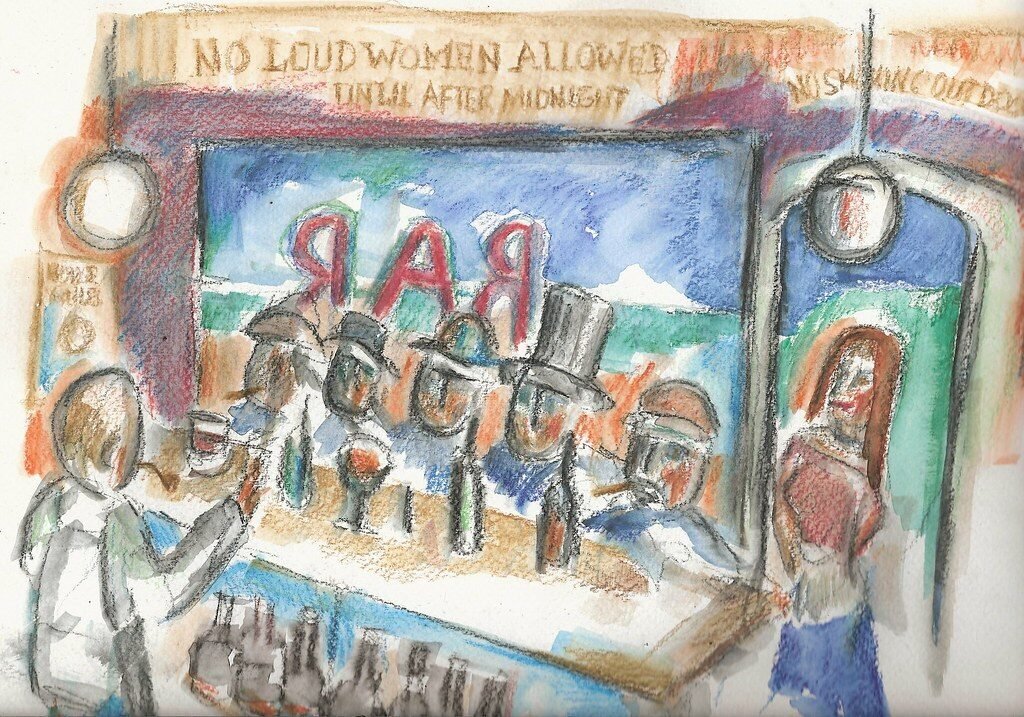
Women learned through history that being somewhere inside the word ‘everyone’ is not the same as being named, counted, or protectedSome women feel
 Women learned through history that being somewhere inside the word ‘everyone’ is not the same as being named, counted, or protected
Some women feel a particular uneasiness when language about women changes.
A woman may be reading about pregnancy and find birthing people. She may be reading about menstruation and encounter menstruators. She may see a government agency use a broad category where she expected to see the word women.
She may not have a law degree. She may not know the dates of the great women’s-rights cases. She may have never read an old statute.
Still, something catches.
She feels the veil.
Then someone reassures her: Women are included. Of course this means you too. (Silly girl 😉
History gives women good reason to ask a follow-up question:
How do we know?
Because women have heard versions of that reassurance before. Americans have used beautiful, expansive words such as people, persons and citizens for centuries. Yet the rights attached to those words were not always distributed as expansively as the words themselves suggested.
For women, and especially for women who were not white, learning the difference could take generations.
Here are some of the women who helped teach us that lesson.
1. Early American Women Learned That “Citizen” Did Not Necessarily Mean Voter
I do not have to know every historical date before I am permitted to notice a pattern. I can notice first and learn more.
Starting before the famous women.
The original Constitution did not establish a universal individual right to vote. Voting qualifications were largely left to the states. Over American history, constitutional amendments and federal laws had to keep expanding and protecting access to the ballot.
That history is worth sitting with because we now read words such as citizen through modern eyes. We know what citizenship is supposed to mean.
Women living then had to learn what it actually meant for them.
After the Civil War, the Fifteenth Amendment prohibited denying the vote because of “race, color, or previous condition of servitude.” It was a monumental achievement, particularly for Black men emerging from slavery.
But sex was not included.
Women could look at the Constitution and see themselves described as citizens without possessing the same protected voting right as men.
That was not a misunderstanding women could fix by being reassured that they were people too.
The law had to change.
2. Black Women Learned That Even “Women” Could Have a Veil Over It
It has been a true unamusing trip watching people declare that “Black women were not considered women.” They leave out “by racists.” And try to use that to get Black women to fight for the erasure their foremothers fought against. AND the erasure we continue to fight against.
This is where women such as Mary Church Terrell become essential to the story.
Terrell was born in 1863. She would spend her life confronting both racial and sex discrimination. She supported women’s suffrage, became the first president of the National Association of Colored Women, and even picketed the White House demanding women’s voting rights. Decades later, when Washington restaurants refused to serve Black people despite earlier anti-discrimination laws, an elderly Terrell was still fighting. She participated in the challenge that ultimately helped bring down restaurant segregation in the District.
Her life reminds us that gaining recognition under one word did not necessarily resolve another exclusion.
Woman could be spoken while white women remained centered.
Citizen could be spoken while Black citizens were denied equal treatment.
Terrell had to live at the intersection of both promises.
That is one reason the history of Black women cannot be tucked into the footnotes of women’s rights history. Black women repeatedly had to ask a harder question:
When you say women, do you mean us too?
And then they often had to fight until the answer became yes.
3. Women Fought for the Vote for Decades, and Even Victory Came in Pieces
Today, women’s voting rights can feel so ordinary that the fight becomes a sepia photograph: women in long dresses holding signs.
That picture is too gentle.
Women petitioned. They organized. They lectured. They marched. Some were arrested. Some engaged in civil disobedience. Suffragists faced heckling, imprisonment, financial punishment, and sexual and physical abuse.
The federal women’s suffrage amendment was first introduced in Congress in 1878.
It finally passed Congress in 1919.
It was ratified in 1920.
Forty-one years passed between introduction and congressional passage. Some of the women who began the struggle did not live to see its victory.
And even 1920 did not finish the job.
The Nineteenth Amendment prohibited denying or abridging voting rights on account of sex. It did not magically remove every other barrier to voting.
Black women could still face racial intimidation and discriminatory voting laws. Native American women faced a different barrier because Native Americans were not universally recognized as U.S. citizens until 1924, and voting obstacles persisted after that. Other women also remained outside practical access to the ballot. Federal protections continued developing through later legislation, including the Voting Rights Act of 1965.
That is how rights often arrive.
Not as a beautifully wrapped package handed over because somebody finally asked nicely.
A door opens three inches.
Women push.
Another law changes.
Women push.
A court recognizes another injustice.
Women push again.
Years pass while real human beings continue living under whatever the law has not yet corrected.
4. Sally Reed Had to Take an Obvious Inequality All the Way to the Supreme Court
By the twentieth century, women could vote. They were unquestionably citizens. They were unquestionably persons.
That did not make sex discrimination disappear.
Sally Reed and her estranged husband both sought to administer their deceased son’s estate. Idaho law preferred males over females when otherwise equally entitled people sought appointment.
Today the unfairness can sound almost cartoonishly obvious.
It still required litigation.
In 1971, Reed v. Reed became the first Supreme Court decision to strike down a law because its sex-based classification violated the Equal Protection Clause.
That date should make us uncomfortable.
1971.
Generations of American women had lived and died before the Supreme Court reached that landmark conclusion about sex discrimination.
This is another thing historical timelines conceal. Between an injustice becoming apparent and a legal remedy finally arriving are human lives.
Women work under the rule.
Women lose opportunities under the rule.
Women raise children under the rule.
Women grow old under the rule.
Then, eventually, we put the victorious court case into a textbook and the suffering before it becomes a sentence.
5. Women Had to Prove That Sex Discrimination Could Hide Inside Ordinary Rules
History makes women suspicious of the sentence, ‘You know we mean you.’ Too often, women discovered that somebody did not
The battles continued because discrimination did not always announce itself with a sign saying NO WOMEN.
Sometimes a policy simply assumed a man’s circumstances were normal.
Sometimes government benefits were structured around husbands and wives differently.
Sometimes educational opportunities that seemed universally available were much easier for males to obtain.
Sometimes everyone was technically a person while the institution had been built around one kind of person.
This is where the women’s-rights litigation of the twentieth century becomes so important.
Women were not merely demanding that society call them human beings.
Everybody already knew they were human beings.
They were demanding that institutions recognize when being female changed how supposedly universal rules actually affected them.
That required something more precise than reassurance.
It required the ability to identify sex.
6. Patsy Mink Helped Put That Precision Into Education Law
Patsy Takemoto Mink knew something about doors that looked open.
She became the first woman of color elected to Congress in 1964. Years earlier, despite graduating from college and wanting to become a doctor, she had encountered discrimination while trying to enter medical school.
She eventually became an attorney and a member of Congress.
There, Mink became one of the central women behind what became Title IX.
Look carefully at the language Congress ultimately enacted in 1972:
“No person in the United States shall, on the basis of sex…”
There is something important happening in that sentence.
Person is broad.
Sex makes the discrimination visible.
The law did not have to stop calling everybody “people” in order to recognize women. It needed enough specificity to identify the characteristic upon which people were being treated unequally.
Mink, Representative Edith Green, and Senator Birch Bayh worked to secure passage. And passage did not mean everyone simply accepted the new order. When opponents later attempted to roll back Title IX, Mink fought to preserve it.
That is another part of women’s history we sometimes forget.
Winning a protection and keeping a protection can be two different battles.
What These Women Left Us
None of these histories proves that every new inclusive term is harmful.
It does teach us something about why some women become uneasy when they are told that a broad word obviously includes them and therefore there is no reason to name women or sex. Women have lived through too much history to know any such thing automatically.
Neither person nor citizen protected women from every law and institution that treated males and females differently.
Black women learned that even women could sometimes be spoken as though everyone knew who was meant, while they were pushed toward the margins.
Women fought for the vote only to discover that one constitutional victory did not eliminate racial barriers to voting.
Women became citizens and voters while sex discrimination remained lawful in areas of American life.
Eventually, women had to make sex discrimination itself visible to law.
These battles took years. Some took decades. Women who began them sometimes died before victory arrived. Meanwhile, women continued living with the consequences.
That history should change how we respond when a woman says she is uncomfortable with language that makes her sex less explicit.
We do not have to agree with every conclusion she reaches.
But perhaps we should stop telling her that she is foolish for noticing words.
Perhaps we should stop saying, Of course you’re included. You know what we mean.
History whispers something different.
Sometimes women feel the veil before they know its history.
A woman may not know the name Mary Church Terrell. She may never have heard the story of Ida B. Wells stepping into that procession. She may not know Sally Reed or Patsy Mink. She may not know that generations of women fought to make discrimination based upon sex something American law could finally see.
She may only know that a word describing her has disappeared from a sentence where she expected to find it.
Before admonishing her, we might listen.
Because her foremothers learned a hard lesson about broad, beautiful words such as citizen, person and everyone:
When the default human being was white and male, everybody else learned that “everybody” did not necessarily mean them.
They learned not to settle for implication.
They fought to be seen.
My compassion does not require my disappearance.
*Know what your state and local legislatures are doing. What laws are they making that may feel like erasure to you and calling “inclusive,” “fair,” or “necessary”?