And do not use Black people’s current struggle as a cloak for taking from women. Black women know both histories too well to be fooled by th
And do not use Black people’s current struggle as a cloak for taking from women. Black women know both histories too well to be fooled by that.
Black women are often asked to carry the struggle, protect the image, defend the group, absorb the harm, and postpone our own safety for “unity.” That is not unity. That is managed silence.
Black women’s safety is not a side issue.
It is not a distraction from justice.
It is one of the first places where justice is tested.
Any movement that asks Black women to surrender safety for unity has not yet finished learning the lessons of justice.
Right now, today, Black people are fighting for rights, safety, breath, livelihood, dignity, land, memory, history, and protection. That struggle is real. It is not theoretical. It has cost blood.
And because that struggle is powerful, sacred, visible, and morally urgent, there have always been people who try to step inside it, borrow its language, wear its suffering, and then demand entry into every protected space attached to it.
But that does not mean Black women should be guilted into surrendering women’s opportunities, women’s boundaries, women’s privacy, women’s scholarships, women’s shelters, women’s awards, women’s healing spaces, women’s sports, women’s language, or women’s sex-based rights in the name of “unity.”
That is not unity. That is extraction wearing a borrowed garment. A person can stand firmly against racism and still recognize when women are being told to disappear. In the way that Fannie Lou Hamer and Gloria Richardson were told to disappear their female-related concerns.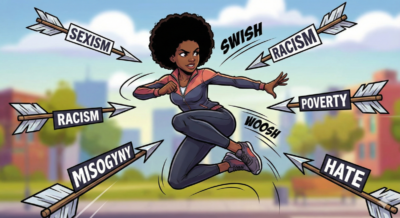
A person can defend Black people’s civil rights and still say women do not have to be the offering plate for every new political demand. A person can reject white supremacy and still reject misogyny. A person can believe in collective liberation without agreeing that the health, well-being, safety, and opportunities of female people should be made permanently negotiable.
These aren’t new concerns. In her 1969 pamphlet, Frances M. Beal was saying something plain and inconvenient:
Black women were not facing “racism over here” and “sexism over there” as separate little storms. They were standing in the place where racism, sexism, and economic exploitation hit at the same time.
Her 1969 essay/pamphlet “Double Jeopardy: To Be Black and Female” argued that Black women were oppressed both as Black people and as female people, and that any liberation movement pretending one part could wait was not telling the whole truth. The essay is widely recognized as a foundational Black feminist text, first connected to the SNCC Black Women’s Liberation Committee and later the Third World Women’s Alliance.
What she was really challenging was the old demand that Black women choose a lane. Anyone’s lane.
She was saying Black women should not have to silence their sex-based concerns to prove loyalty to Black liberation. She also rejected the idea that white middle-class feminism could speak for Black women while failing to confront racism, poverty, labor exploitation, and imperialism. In other words, she was not asking Black women to be absorbed by either movement. She was insisting Black women needed an analysis that told the truth about their whole lives.
A few core points:
1. Black women were being exploited economically.
Beal talked about how Black women were pushed into low-wage work, domestic work, service work, and other undervalued labor. She connected racism and sexism to capitalism, showing how Black women’s work was necessary but disrespected.
2. Black liberation could not mean Black male leadership only.
She challenged male supremacy inside Black movements. Her argument was not anti-Black men. It was pro-truth. She was saying liberation cannot be real if Black women are still expected to obey, serve, stay quiet, or wait their turn.
3. White feminism was not enough.
Beal criticized white women’s liberation when it failed to face racism and class exploitation. She saw that many white women were fighting to escape domestic confinement, while many Black women had always had to work outside the home under harsh conditions. Different lives required different political truth-telling.
4. Reproductive freedom had to include protection from abuse by the state.
She wrote about contraception, abortion, sterilization, and the danger of population-control politics targeting nonwhite women. So her point was not a simple “choice” slogan. She was saying Black women needed bodily autonomy without racist medical control.
5. If Black women are not free, the movement is not free.
That is the heartbeat of it. Beal was saying you cannot measure liberation by whether Black men gain public power while Black women remain unsafe, overworked, unheard, or controlled.
Frances Beal was saying Black women are not auxiliary humans. We are not supposed to fight racism with our womanhood tied behind our backs. We are not supposed to join women’s movements that erase our Blackness either. Any freedom struggle that asks Black women to divide themselves has already misunderstood freedom.
Little girls deserve safety. Little girls deserve safety even when the warning comes from someone we dislike. Your worst enemy can be right once or twice in a lifetime. That does not make them holy. That does not make them trustworthy. It does mean we are responsible for separating the signal from the poison. Adults do not get to ignore danger just because the wrong person pointed at it first. Children should not have to pay for our tribal reflexes, our pride, or our fear of being seen agreeing with someone we despise.
Not theoretical safety. Not safety after every adult has finished performing their politics. Not safety after every group has negotiated whose feelings matter most. Not safety only when the “right” person says it in the “right” language.
Safety. Privacy. Boundaries. Protection. The real kind. The genuine kind.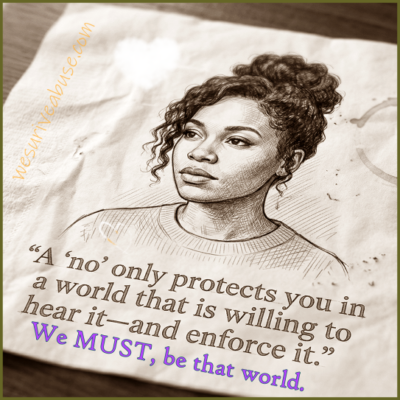
Adults who are willing to look foolish, unpopular, unfashionable, and inconvenient if that is what it takes to keep a child from being harmed.
Friendly adults respect a child’s safety needs.
They do not demand hugs, secrecy, privacy, access, or obedience to prove…. love. No free hugs. No free access. Nothing. Genuine relationship and trust building.
And yes, your worst enemy can be right once or twice in a lifetime.
That does not make them your leader. That does not make them your friend. That does not erase the harm they have done.
That does not mean you join their camp, borrow their worldview, or hand them your trust.
It simply means truth is not owned by tribes.
A broken clock can tell the time correctly twice a day, and a dangerous person can occasionally point toward a real danger. Wisdom is knowing how to take the warning without taking the poison.
Friendly people demonstrate friendly behavior by respecting my safety needs as a female human being on this dangerous to women planet. Not by announcing how kind, inclusive, spiritual, open-minded, educated, progressive, non-racist, or loving they are or have always been. Friendliness is not proven by charm. Friendly behavior is shown through respect.
A person who is truly friendly does not mock your boundaries.
They do not rush your “no.”
They do not make your caution into an insult against them.
They do not demand access on the front-end and then call it “trust.”
They do not ask you to prove your pain before they honor your need for protection.
They do not say, “But I’m a good person,” as if their self-image outranks your lived reality.
That matters for children. That matters for Black women. That matters for Survivors.
That matters for anyone who has learned, the hard way, that danger does not always arrive snarling. Sometimes danger arrives smiling, fluent in the language of care.
The old trick is to say:
“If you do not make room for this, you are betraying the larger struggle.”
Where “this” is anything the visitor wants it to be that day.
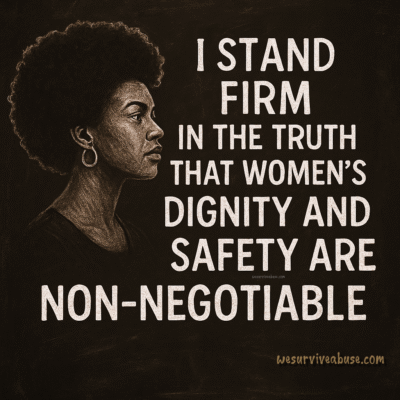 But some of us know better now.
A larger struggle that requires women to lose language, boundaries, privacy, safety, and opportunity is not liberation. It is simply another house where women are expected to cook, clean, clap, sacrifice, and be quiet.
Black women do not have to choose between the two because Black women live at the crossing of both.
And that crossing does not make us confused.
It makes us witnesses. From Sojourner Truth to Anna Julia Cooper, Pauli Murray, Gloria Richardson, Dorothy Height, Frances Beal, Combahee, Audre Lorde, and bell hooks, Black women have been saying the same sacred thing in different keys: do not ask us to choose between Black freedom and women’s safety. We are not half-human in either direction.
Because sometimes people use a true concern to smuggle in a dangerous agenda.
And by the way, we see the men from all backgrounds who have NEVER spoken up for rape, violence, and abuse victims but suddenly become verbose to the max when it comes time to convince women to lower boundaries around women and children. Fewer protections? More access? And, more harm too? I’m guessing that we can expect your continued silence for harmed women and children then, too?
The Economist: Why Nations that Fail Women FAIL – WESurviveAbuse
Until Respect for All Includes Respect for Women’s Boundaries – WESurviveAbuse
65 Beliefs Some Men Hold About Women: Control, Boundaries, and the Fight for Choice – WESurviveAbuse
The Myth of Easy Access: Why You Don’t Owe the World Your Self – WESurviveAbuse
Why ‘Being Loyal’ Shouldn’t Cost You Your Safety, Dignity, or Peace – WE Survive Abuse