I deeply despise stories that depict women finding their way through to the other side of sex work or a season of promiscuity as being synonymous with change for the whole community. But then people often pretend that “fixing women” will fix an entire community. And to these people, women are always in need of “deep repair.”
They turn a structural crisis into an individual female redemption story. Men’s entitlement, buyers’ demand, poverty, racism, abuse, coercion, unequal wages, housing insecurity, pornography industries, trafficking networks, and cultural double standards remain untouched. Yet the woman is expected to “change,” “value herself,” “close her legs,” leave sex work, marry, become modest, or finally recognize that she was supposedly living wrongly.
That is not liberation. It is reputation management for the culture.
Because, what about the men? ……..
Granted, woman may personally decide to become more sexually selective, leave sex work, practice celibacy, marry, or change her life in any way she chooses. Her decision deserves respect. But her transformation cannot serve as the moral solution to systems she did not create. Nor should women who do not follow that path be treated as cautionary tales, failed women, or spiritually inferior.
The deeper questions are:
-
Why is female sexual behavior treated as a public emergency while male sexual conduct is treated as private appetite?
-
Why is the seller stigmatized more than the buyer?
-
Why must a woman “see the light,” while men are rarely asked to confront entitlement, exploitation, dishonesty, coercion, abandonment, or violence?
-
Why do stories reward women for becoming acceptable to patriarchal society rather than demanding that society become safer and more just for women?
-
Why is respectability offered in place of housing, healthcare, fair wages, protection from violence, and genuine alternatives?
-
Why does the culture prefer a repentant woman to an accountable man?
These narratives also flatten women’s lives. They assume that sexual restraint automatically equals wisdom, healing, or dignity, and that sexual openness automatically signals damage or moral confusion. Neither is necessarily true. A woman can be sexually selective and still be manipulated, abused, or self-abandoning.
Another woman can have many partners and still possess boundaries, self-knowledge, and integrity. The moral questions should be consent, honesty, safety, power, exploitation, and freedom—not whether a woman has achieved social respectability.
The same is true of sex work. Some women experience coercion, violence, economic desperation, or trafficking. Others describe agency, livelihood, ambivalence, or some mixture of all of these. Serious analysis must make room for those differences without romanticizing the industry or degrading the women in it. Protecting women means expanding their real choices, not demanding a conversion narrative from them.
The story worth telling is not simply, “She changed.”
It is: Who harmed her? Who profited? Who was protected? What options did she actually have? What would justice require? What must men, institutions, and the wider culture change?
A woman’s personal transformation may be meaningful. But it is not a substitute for collective accountability. Women should not have to become “good” before the world is required to stop exploiting them.
That said, women arriving to themselves, for themselves, is a powerful thing. FOR HER.
I wanted to share this tale from a source that frequently speaks on this issue in a way that is more holistic than many others.
If you can’t read the text on the image: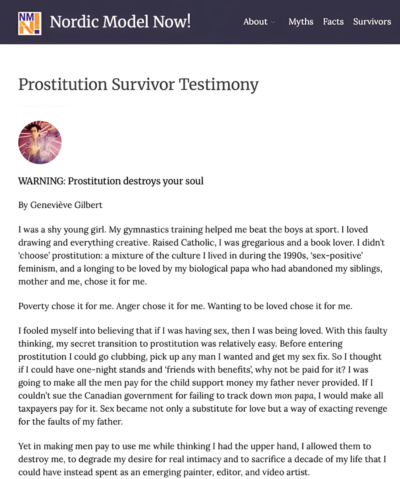
“I didn’t ‘choose’ prostitution: a mixture of the culture I lived in during the 1990s, ‘sex-positive’ feminism, and a longing to be loved by my biological papa who had abandoned my siblings, mother and me, chose it for me. Poverty chose it for me. Anger chose it for me. Wanting to be loved chose it for me.
I fooled myself into believing that if I was having sex, then I was being loved. With this faulty thinking, my secret transition to prostitution was relatively easy. Before entering prostitution I could go clubbing, pick up any man I wanted and get my sex fix. So I thought if I could have one-night stands and ‘friends with benefits’, why not be paid for it? I was going to make all the men pay for the child support money my father never provided.
If I couldn’t sue the Canadian government for failing to track down mon papa, I would make all taxpayers pay for it. Sex became not only a substitute for love but a way of exacting revenge for the faults of my father. Yet in making men pay to use me while thinking I had the upper hand, I allowed them to destroy me, to degrade my desire for real intimacy and to sacrifice a decade of my life that I could have instead spent as an emerging painter, editor, and video artist.”
posted by @SexIndustryRes on X.com
Geneviève Gilbert | Nordic Model Now!
Many Black radical feminists, womanists, and Black women scholars have argued that if people want to understand prostitution, sexual exploitation, or what is often labeled “promiscuity,” they should stop treating individual women as the primary moral problem and instead examine the social, economic, and gendered conditions that shape sexual choices and vulnerabilities
Black radical women have long challenged society to interrogate men’s behavior more directly. Their questions include:
-
Why are boys taught that masculinity is proven through sexual conquest?
-
Why is male sexual aggression often excused as “natural”? Even when he is what our current society sees as “non-gender conforming.”
-
Why do so many men consume pornography that depicts degradation or violence toward women?
-
Why are men praised for promiscuity while women are shamed?
-
Why is demand for prostitution treated as inevitable instead of something that can be questioned?
-
Why do men who purchase sex often escape public scrutiny while women bear the stigma?
-
What does healthy, accountable masculinity require?
-
How should men be educated about consent, mutuality, and respect?
-
Why do some institutions protect powerful men accused of sexual exploitation?
For further reading, several Black women thinkers have explored these themes in different ways:
-
bell hooks repeatedly asked how patriarchy teaches men to equate domination with love and masculinity, arguing that transforming men is essential to ending gender oppression.
-
Patricia Hill Collins examined controlling images like the “Jezebel” stereotype and how they have historically justified the sexual exploitation of Black women.
-
Angela Y. Davis connected prostitution, incarceration, labor, race, and economic inequality, urging analysis of the structural conditions that constrain women’s choices.
-
Audre Lorde encouraged examining how systems of domination shape intimacy, sexuality, and power rather than blaming marginalized individuals.
-
Barbara Smith argued that race, class, gender, and sexuality cannot be understood separately because they intersect in lived experience.
-
Alice Walker emphasized healing, dignity, and the humanity of Black women whose lives have been marked by violence and exploitation.
-
Joan Morgan explored the tensions between sexual agency, pleasure, misogyny, and accountability in Black communities.
I deserve care, not exploitation.
I deserve protection from violence, not blame for surviving it.
If I have been exploited, I am not the exploitation.
If I have made choices I would not make today, I remain worthy of love.
Nellie Jackson: After All Her Yeses, They Still Could Not Honor Her No – WE Survive Abuse